
Business Model Slide: How to Show Investors You Can Make Money and Scale
The use of funds slide answers a question no other slide answers directly: how you plan to allocate capital. Not how excited you are about your market. Not how strong your team looks on paper. Whether you actually know what the money needs to accomplish, and in what order.
Author: Tanya Slyvkin, CEO & Founder, Whitepage Studio

A business model slide is where investors decide whether your economics can work and whether the model scales. Here is how to build one that holds up to scrutiny - revenue model, unit economics, and the signals investors actually check.
Starting a company is hard. Funding it is harder. Most startups struggle in the early days because they have little or no traction, and investors need a reason to believe the numbers will eventually move in the right direction. A pitch deck is your shortcut to that conversation, and inside the deck, the business model slide is the page investors return to when they want to answer one question: can this company make money, and will the unit economics improve as it grows?
As a presentation design agency, we have reviewed hundreds of pitch decks. The business model slide rarely wins a round on its own, but it loses them often. Founders either overload it, dress it up without numbers, or describe a model that quietly contradicts their financials slide three pages later. This guide walks through what the slide should actually answer, the elements investors probe, and how to keep it consistent with the rest of your deck.
What is a Business Model Slide?
A business model slide answers two questions: how does your company make money, and does the model get more efficient as it grows? Everything else on the slide supports those two answers.
In one minute or less, a reviewer should be able to pull out:
- Who pays you, and for what
- How you price it (subscription, transactional, marketplace take-rate, licensing, usage-based)
- What it costs you to acquire and serve a customer
- Why the gap between price and cost widens, not narrows, at scale
If they cannot, the slide is doing too much. A business model slide is not a business plan. It is a one-page argument that the economics work.
Why Do You Need a Business Model Slide?
Investors read decks fast, but they slow down on a handful of slides, and this is one of them. DocSend's pitch deck research found investors spent roughly 48% more time on the business model section of decks between 2022 and 2023. Monetization scrutiny has been rising, not falling, in a tighter capital environment.
No single slide closes a round. But this one is where investors decide whether the economics can work, and if the numbers do not square with the rest of your deck, the conversation often ends here regardless of how strong the product or team slides were.
A few reasons to give the slide real attention:
- The business model section is one of the most scrutinised parts of a pitch deck, and skimping on it telegraphs that you have not done the work.
- A clear model shows you have thought through the mechanics of the business, not just the vision.
- Specificity reads as scalability. Vague aspiration reads as wishful thinking.
The job is not to dress up the slide. The job is to make the economics legible.
How To Create a Business Model Slide for Your Pitch Deck
The slide should align with your company's stage, the deck's overall narrative, and the realities of your category. Think through a few things before designing:
- Target audience for the deck (different investors read decks differently)
- Likely objections and how the slide preempts them
- Demonstrated progress and traction
- Revenue and investment projections
- Pricing strategy and competitive pricing context
Within those constraints, lean on expert presentation advice to land the slide well.
Define Scalability Mechanically
Scalability is the most overused and least understood word in pitch decks. The mechanical definition: revenue grows faster than the cost to serve. That is it. If the cost to acquire and serve the next customer rises in step with the revenue that customer brings in, you do not scale. You grow. The business model slide should make that asymmetry visible, even at the level of a directional ratio.
Traction
Show what you have done. Concrete numbers - users, revenue, retention - belong here, not adjectives. If you do not have revenue yet, show the operational proof points: pilots signed, LOIs, design partners. The point is to give investors something checkable.
Revenue Model and Pricing Strategy
Explain how you price and why. Is the unit a seat, a feature tier, usage, or transactions? How does your price compare to substitutes and competitors? Pricing is a strategic decision, not a number you picked, and showing the thinking signals maturity. Investors will ask how price has changed as you learned what customers will pay. Have an answer.
Investments and Use of Funds
Be specific about what the raise pays for and what milestones it unlocks. Vagueness here is a credibility tax. A clear use-of-funds breakdown, even at high level, makes the rest of the model feel like it was built by someone who has thought about the next 18 months.
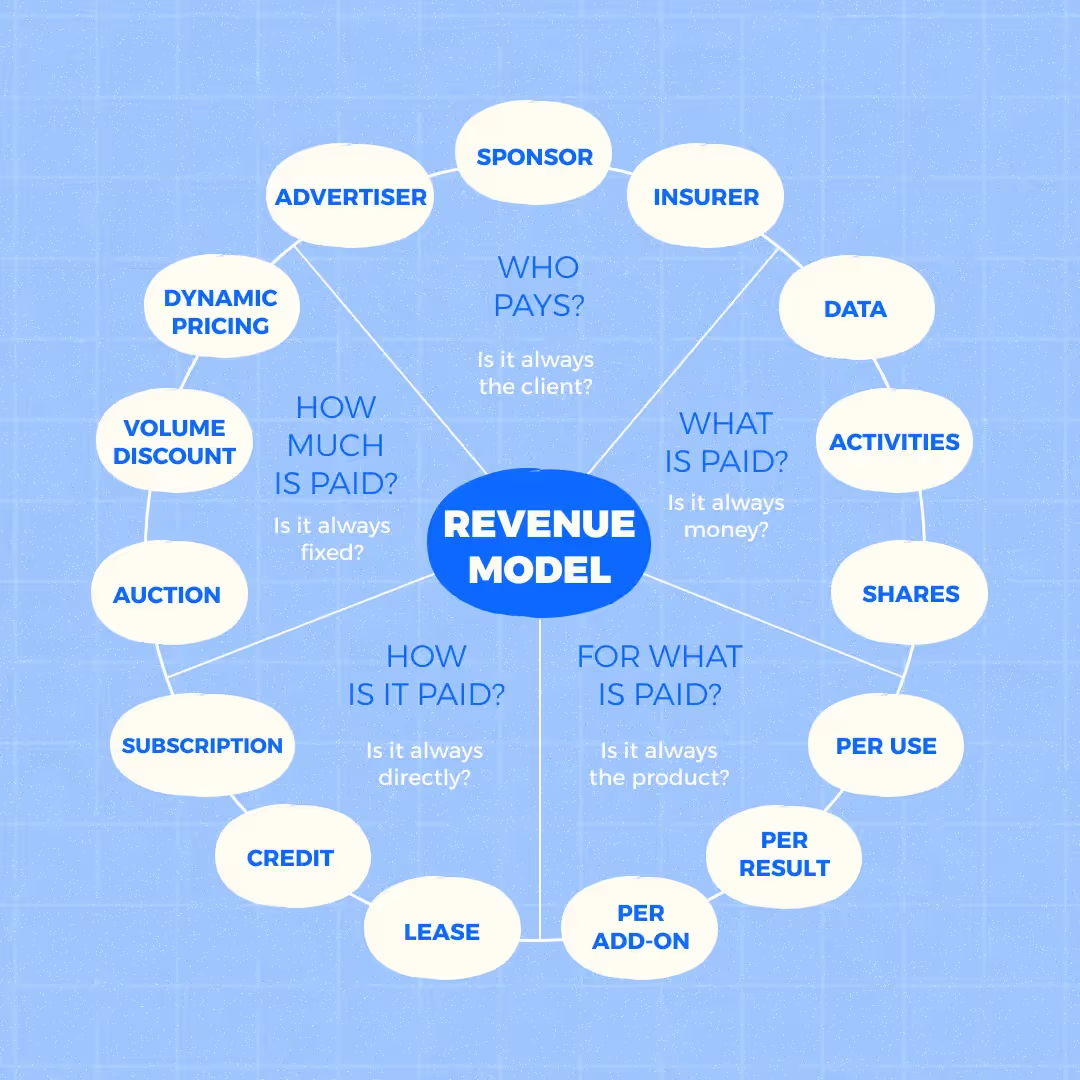
Business Model vs Revenue Model: They Are Not the Same
These two terms get used interchangeably, and it costs founders credibility.
The business model is how your company creates, delivers, and captures value end-to-end. It covers who the customer is, what you sell, how it reaches them, what it costs you to deliver, and how you make money on the difference. The revenue model is a subset of that: the monetization mechanics. Subscription, transactional, marketplace take-rate, licensing, usage-based pricing.
Investors notice the conflation. When a founder says "our business model is SaaS," what they actually mean is "our revenue model is subscription." The business model is bigger than the price tag. On your slide, cover the whole model: who pays, what they pay for, why, and what it costs to deliver. Keep deep pricing levers, CAC details, and payback analysis for the revenue or financials layer where they belong, and make sure the market size slide gives the model a credible TAM to grow into.
Key Elements on the Business Model Slide
Five elements belong on almost every business model slide, plus a revenue-model taxonomy that shapes how you present them.
Value Proposition
Your value proposition is the core. One or two lines on what you sell, to whom, and why it beats the alternative. The mistake here is reusing the opening slide language. The value prop on the business model slide should be tighter and more economic. "We save mid-market logistics teams 14 hours a week on dispatch" reads better than "we are reimagining logistics."
Target Market
Name the segment you are selling to right now, not the eventual addressable universe. A focused beachhead reads as a real business. A market the size of a continent reads as a hope. Mention how you reach the segment - inbound, outbound, partnerships - so the model connects to a go-to-market.
Revenue Streams and Revenue Model
Most companies fit one of five categories:
- Subscription - recurring fee, usually monthly or annual. Predictable, but requires retention.
- Transactional - per-purchase or per-order. Volume-driven, exposed to demand swings.
- Marketplace / take-rate - percentage of GMV. Scales well, but requires liquidity on both sides.
- Licensing - one-time or annual fee for use of IP or software. Lumpy but high margin.
- Usage-based - charge per unit consumed (API calls, compute, transactions). Aligns price with value, but harder to forecast.
Focus on 1 to 3 core revenue streams. Label anything else as secondary or future. A long list of streams reads as unfocused, not ambitious. Clarity reads as more scalable than clutter. How the streams tie into unit economics is the next section.
Costs and Expenses
Know your cost structure to the point of being unsurprised by any question. Major cost categories, what scales linearly with revenue and what does not, where margin comes from over time. Even one credible number lifts the slide.
Distribution Channels
How the product reaches the customer. The mistake is listing every possible channel. The better version names the one or two channels that are actually working and explains why. If you have CAC by channel, that is even better, though the detail usually lives on the financials slide.
The Unit Economics That Make the Slide Credible
A business model slide without unit economics is a story without a math check. Investors will work the numbers themselves if you do not, so it is better to put the work on the page.
A handful of metrics come up almost every time:
- CAC (Customer Acquisition Cost) - the fully loaded cost to acquire one paying customer. Sales, marketing, onboarding.
- LTV (Lifetime Value) - the gross profit a customer generates over their relationship with you.
- LTV:CAC ratio - rule of thumb is roughly 3:1. Below 1:1 you are losing money on every customer; above 5:1 you may be under-investing in growth.
- Payback period - how long until CAC is repaid. Under 12 months is healthy for most SaaS, 18 to 24 is workable, beyond that gets harder to defend.
- Gross margin - revenue minus cost of revenue. Software 70-85%. Marketplaces 60-75%. AI-heavy products often lower until inference costs settle.
- ARPA (Average Revenue per Account) - useful for understanding pricing and segmentation.
These are rules of thumb, not laws. A consumer subscription business can defy "normal" CAC payback if retention is exceptional. A marketplace can run lower gross margins if take-rate is rising.
A worked example helps. Imagine a B2B tool with CAC of $10, monthly price of $30, gross margin of 70%, and 14-month average retention. Monthly gross profit per customer is $21. LTV is $21 x 14 = $294. LTV:CAC is 29:1. Payback is well under a month. Those are strong numbers. The real question becomes whether they hold as you scale CAC up to acquire colder customers.
If you are pre-revenue, do not invent data. State the assumptions, name the unknowns, and show the model you would run once you have numbers. Investors at pre-seed expect that. They do not expect fiction.
MetricWhat it meansHealthy range (rule of thumb)CACCost to acquire one customerDepends on price point and channelLTVGross profit per customer over lifetimeShould exceed 3x CACLTV:CACRatio of lifetime value to acquisition cost~3:1Payback periodMonths to recover CAC<12 months for SaaSGross marginRevenue minus cost of revenue, as %70-85% for softwareARPAAverage revenue per accountTrend it over time
For the modelling side in depth, our financial modeling service and the financials slide guide cover the build-out. Whitepage has built financial models and decks across hundreds of completed projects, and the business model slide is where most of that work shows up.
Make the Slide Reconcile with Your Financials and Market Size
The business model slide does not live alone. It has to reconcile with the slides on either side of it - market size and financial projections - or the deck reads as inconsistent. Investors catch this fast. If your slide implies ARPA of $300 a month but your projections assume $1,200 a month by year three with no plan for how to get there, the gap gets flagged in the first read.
A three-slide consistency check before you send:
- Market size slide. Does your TAM/SAM/SOM math allow for the revenue projections downstream? If your SOM is $40M and year-three revenue is $50M, the math has already broken.
- Business model slide. Does the revenue model and pricing implied here produce the same per-customer numbers your financials use?
- Financial projections slide. Do the growth assumptions reconcile with the CAC, payback, and retention numbers your business model implies?
When those three slides agree, the deck reads as built by someone who knows the business. When they do not, it reads as a story stitched together from templates.
A note on AI products specifically. Investors have grown more skeptical of "we'll monetize later" framing, and increasingly probe whether AI wrappers will face margin compression as inference costs shift or as foundation models commoditise the underlying capability. This is an emerging line of questioning, not settled doctrine, but it is showing up in more meetings. If you are an AI-native company, show durable gross margin, explain why your pricing power is not borrowed from a model provider, and have a credible answer to "what happens when GPT-X is 10x cheaper next year?" Tie your use of funds back to defensibility. The use of funds slide guide covers how to frame this.
The Business Model Slide by Model Type and by Stage
There is no universal template, because a marketplace slide and a B2B SaaS slide are not trying to communicate the same thing.
B2B SaaS. Lead with ACV, gross retention, net retention, and gross margin. The story is about contract value and expansion.
B2C subscription. Lead with monthly price, retention curve, payback period, and ARPU. The story is about retention.
Marketplace. Two-sided economics. Take-rate, GMV, supply and demand liquidity, and cohort behaviour on both sides. The story is about thickening the network.
Transactional / e-commerce. Average order value, contribution margin per order, repeat rate, and CAC by channel.
Usage-based / API. Price per unit, expansion within accounts, gross margin including infrastructure cost, and how usage grows with customer maturity.
Stage matters as much as model. The slide investors expect at pre-seed is not the slide they want at Series A:
- Pre-seed. Design-partner pricing, clearly labelled assumptions, and a credible plan to validate them. Honesty about what is unknown is the asset here.
- Seed. Early CAC and LTV signal from real customers, even at small numbers. The first cohort data is worth more than the projection.
- Series A. Real retention curves, cohort behaviour, and unit economics that hold up as you scale spend. By this stage, projections without cohorts are a red flag.
For the broader deck context, our step-by-step deck guide walks through how the business model slide fits with the rest of the narrative.
Start with a Business Model Canvas
The Business Model Canvas is a useful starting point for thinking through the model before you design the slide. Like other pitch deck design services, we use it as a planning tool, not a final output.
The canvas was developed by Alexander Osterwalder and Yves Pigneur to simplify how a business model is described. It splits the model into nine building blocks:
- Customer Segments
- Value Propositions
- Channels
- Customer Relationships
- Revenue Streams
- Key Resources
- Key Activities
- Key Partnerships
- Cost Structure
Working through the nine blocks forces a team to spot gaps - usually around channels, costs, or partnerships - before they show up as inconsistencies in the deck. The canvas itself does not go on the slide. It is the scaffolding the slide is built from.
7 Examples of Successful Business Model Slides in Pitch Decks That Raised Millions
These examples come from companies that have raised real money. The business model slide was a contributing factor, not the cause. Decks are read in context, and capital decisions are made on the strength of the whole story. Still, each of these slides does something worth borrowing.
Archer Aviation
Archer Aviation's business model slide is informative without being cluttered. It conveys the value proposition, names specific numbers, and ties revenue to a clear timeline for hitting commercial milestones. Archer's deck, which included a clear business model slide, raised $1.1 billion at a $2.7 billion valuation.
SoFi
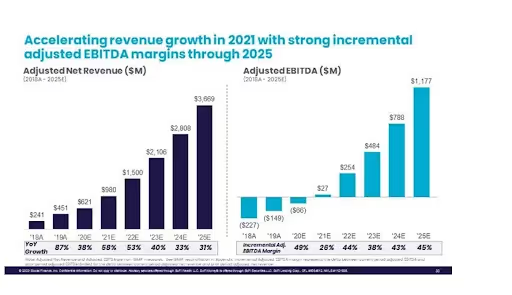
SoFi, the American personal finance company, uses its business model slide to visualise anticipated revenue across several drivers and to show how each driver responds to different conditions. SoFi's deck, which included a clear business model slide, raised substantial growth funding ahead of its public listing.
Clover Health
Clover Health is a US healthcare company whose pitch decks have been studied widely as pitch deck examples. The business model slide blends operational statistics with a clear view of the company's positioning. Clover's deck, which included a clear business model slide, raised $1.2 billion at a $3.7 billion valuation.
Arrival
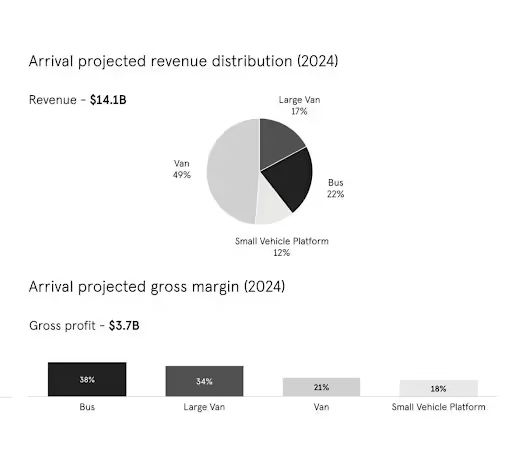
Arrival's slide stands out for breaking out profit by mode of transportation, so the reader can see the contribution of each line. Arrival's deck, which included a clear business model slide, raised significant funding during its growth phase.
WeWork
A decade ago, WeWork pitched shared office space as a category. Their Series D deck, which included a clear business model slide, raised $355 million. The slide leaned hard on scalability - membership economics that improved with each location - and made the model legible to investors who were not industry insiders.
Buffer
Buffer's deck is one of the simplest in circulation, which is its strength. The business model slide is concise, the formatting is consistent, and the brand feel carries through every page. Buffer's deck, which included a clear business model slide, raised $500K in early funding.
Bliss
Bliss is a technical product, but the deck made the model accessible. The team paired visual design with data-driven framing so the slide reads cleanly even for non-technical reviewers. Bliss's deck, which included a clear business model slide, raised $750K.
Studying these examples is useful, but the goal is not to copy a layout. It is to make the economics of your own business legible to someone who has never seen your product.
Common Mistakes to Avoid
The same handful of mistakes show up over and over on business model slides. Avoiding them is most of the work.
- Too many revenue streams. Listing five or six revenue lines does not look ambitious. It looks unfocused. Pick the 1 to 3 that drive the model and label everything else as secondary or future.
- No real numbers. If the slide has no CAC, no ARPA, no margin, no retention, just adjectives, it reads as a placeholder. Even one credible number lifts the slide.
- Ignoring cost structure. Revenue without context on what it costs to produce that revenue is half the picture. Investors will fill the gap with worst-case assumptions if you do not.
- Projections without validation. Year-three revenue figures pulled from a template are spotted in seconds. Tie projections to assumptions you can defend.
- Text-only slides. A wall of bullets on the business model slide is a missed opportunity. A simple diagram or table communicates the model faster than a paragraph.
These are mistakes that can strengthen the slide once they are fixed. None of them require new content. They require editing what is already there.
Create a Success-Driven Pitch Deck With Whitepage
The slide is most convincing when the numbers hold up. The story matters, but the math has to support it, and the slide has to reconcile with the rest of the deck. That takes structural work, not styling.
We have designed and reviewed hundreds of pitch decks across stages and sectors, and the business model slide is where we spend a disproportionate share of the editing time. Contact us for a consultation to talk through your deck.
FAQ
How To Make A Presentation For A Business Model?
Keep the slide concise, specific, and economically literate. Show how you make money, what it costs to make it, and why the gap between the two widens with scale. Put yourself in the audience's seat. Investors are looking for a model they can stress-test in their heads in under a minute. Visuals help where they replace words, not where they decorate them.
How Do You Describe A Business Model In A Pitch Deck?
Start with the value proposition - what you sell and to whom - then walk through the target market, the revenue streams and pricing, the cost structure, and the distribution channels. The aim is to make four things obvious in under a minute: who pays, what they pay for, what it costs you to serve them, and why the margin gets better as you grow. Anything that does not support those four points is usually a candidate to cut.
How Do You Pitch A Business Model?
Lead with the economics, not the vision. A strong pitch of the business model is concise, specific, and consistent with the rest of the deck. Open with a hook that frames the opportunity in concrete terms (a number, a behaviour, a market shift), then walk through how you make money and where the leverage is. The slide is most convincing when the numbers hold up under questioning, so rehearse the obvious follow-ups before you take the meeting.
What is the difference between a business model and a revenue model?
The business model is how you create, deliver, and capture value across the entire company: customer, product, delivery, costs, and monetization. The revenue model is the narrower piece - the mechanics of how you charge (subscription, transactional, take-rate, licensing, usage). Founders often use the terms interchangeably, which costs them credibility with investors. The business model vs revenue model section covers how to keep them straight on the slide.
What unit economics should be on a business model slide?
At minimum, show CAC, LTV, gross margin, and a payback period. If you have it, ARPA and retention add useful texture. The LTV:CAC ratio rule of thumb is roughly 3:1, and SaaS payback under 12 months is considered healthy. If you are pre-revenue, state assumptions rather than invent data. The unit economics section covers what each metric means and how to present it.
What are common business model slide mistakes?
The most common mistakes are listing too many revenue streams, omitting real numbers, ignoring the cost side, presenting projections without validation, and relying on text alone with no visual. Each is a credibility leak. The common mistakes section details how to fix them without rewriting the slide from scratch.
What does a business model slide look like for a marketplace?
A marketplace slide leads with two-sided economics: take-rate, GMV, and the liquidity dynamics on both supply and demand. Unit economics need to be shown per side, because supply CAC and demand CAC are different problems. The slide should also speak to how the network thickens over time. The by model type section covers framing across SaaS, marketplaces, transactional, and usage-based models.
What It’s Like To Work With Us
reviews


867 BOYLSTON ST
BOSTON, MA 02116


