





























.avif)

.avif)
.avif)


























Get a guide to creating pitch decks presentation



.png)

- Investors spend an average of 3 minutes 44 seconds reviewing a pitch deck. Only 12% of decks are read in full. Your first slide has 23 seconds to earn the next one.
- 84.6% of seed-funded startups fail to raise Series A within two years — double the failure rate from 2018. The deck's job has never been harder.
- Founders acknowledged that AI-generated pitch decks are a legitimate starting point — but they produce structure, not strategy. Logical sequences are not the same as emotionally compelling narratives.
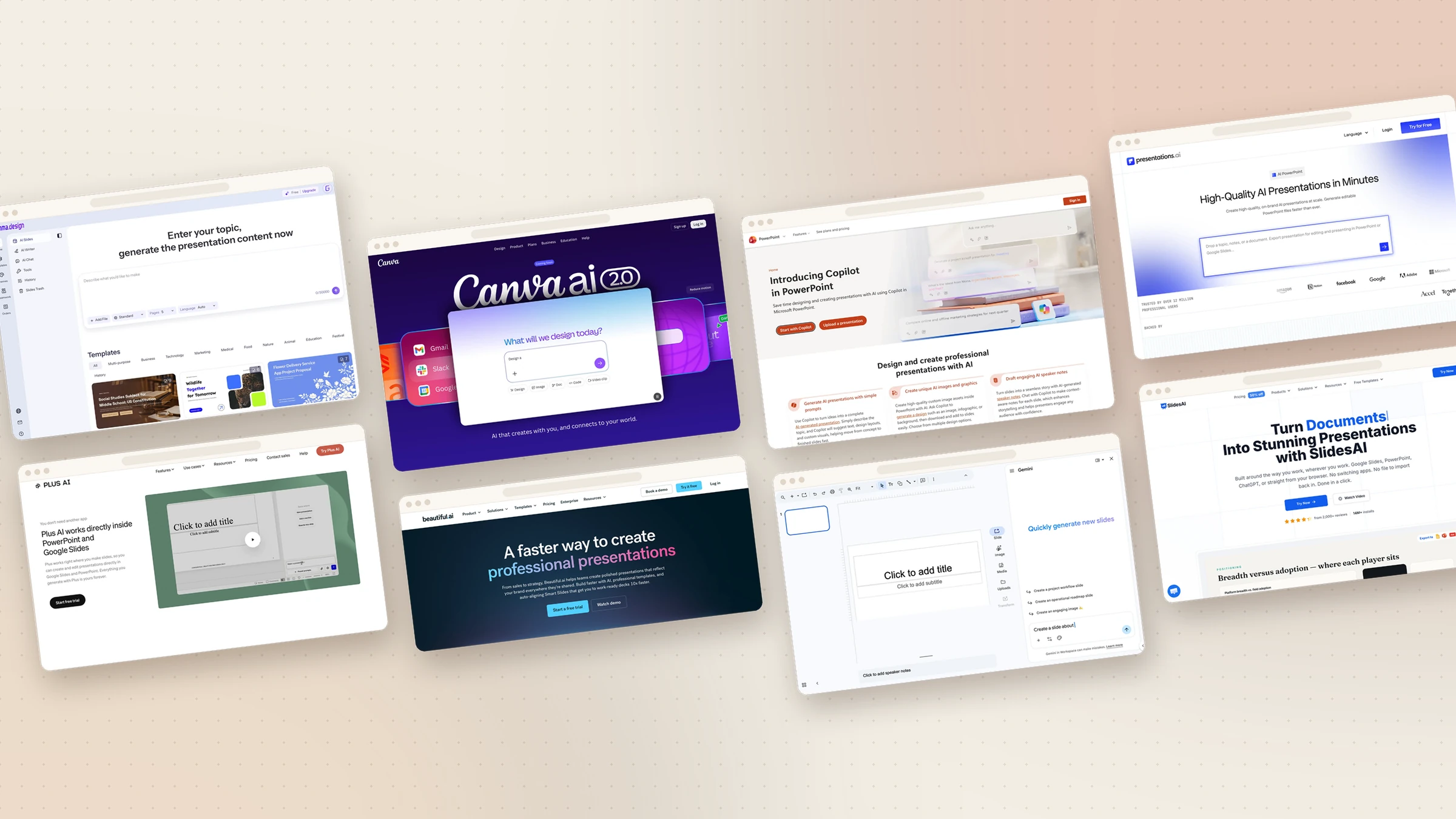
- The most popular AI tools founders use include ChatGPT, Gamma, Beautiful.ai, Tome, and Slidebean. Each has genuine strengths, and each has the same core limitation: it cannot build an investor-specific narrative.
- Across 20 chats with founders, we identified five specific failure patterns that repeat regardless of which AI tool was used: narrative architecture; generic competitive positioning; disconnected financial projections; one deck foe all audiences; generic design output of the deck.
The fundraising landscape has fundamentally shifted. Global VC funding reached $368.3 billion in 2024, up 6.5% year-over-year, with H1 2025 surging another 25% to $189.93 billion (KMPG, 2024). Capital is flowing — but it is concentrating on fewer, larger deals. GenAI alone attracted $87 billion in the first eleven months of 2025, a 65% jump from the prior year (EY, 2025).
For founders outside the AI hype cycle, this concentration means more competition for every dollar. A seed-stage founder now contacts 80 to 150 investors and sits through 40 to 60 meetings before receiving a term sheet (SheetVenture, 2026). At Series A, those numbers climb to 100+ investor contacts and 50 to 80+ meetings. The median gap between seed and Series A has stretched to 774 days — nearly 84% longer than it was in late 2021 (SaaStr, 2025).
In this environment, every touchpoint with an investor carries outsized weight. Your pitch deck is not a slide show — it is a decision document. And increasingly, the first reviewer may not be human at all. VCs at firms like EQT and Moonfire Ventures are using AI to pre-screen decks before a partner ever opens the file.
Here is the paradox: AI tools are making it easier to create an AI-generated pitch deck at the exact moment when the bar for what those decks need to accomplish has never been higher.
Let us be clear about something before we go further. AI presentation tools are not useless. The market for these tools reached somewhere between $748 million and $3.49 billion in 2024, depending on how you define the category, and is growing at 11 to 20% annually (WinMarketResearch, 2025). The most widely used AI tools among startup founders — ChatGPT in pitch deck design, Gamma for slide generation, Beautiful.ai for templated layouts, Slidebean for structure, and Tome for narrative frameworks — each solve a real problem.
AI is legitimately good at generating a first-draft structure in minutes, compiling market research and competitive data, refining grammar and clarity in existing content, and applying consistent formatting from templates. A founder can go from a blank screen to a 12-slide skeleton in under an hour, significantly saving on pitch deck design costs. That is a real productivity gain, and dismissing it would be dishonest. However, as one of the founders shared in the chat:
"I got something that looked okay in two hours, then spent three weeks trying to make it feel right."
The problem starts when founders treat that skeleton as a finished product — or spend 40+ hours iterating AI outputs in circles, ending up roughly where they started.
After reviewing consultations with more than 100 founders — from pre-seed startups to companies preparing for IPO roadshows and NASDAQ listings — we identified five failure patterns that appear regardless of which AI tool was used. These are not theoretical critiques. They are recurring, observable problems that we hear described in nearly identical language across industries.
AI produces logical sequences. Slide one introduces the problem. Slide two presents the solution. Slide three shows the market. This is structurally correct and emotionally flat.
Investors are not logic processors. Research on progressive commitment in decision-making shows that people say yes to big asks after a series of small agreements. The peak-end rule, identified by Daniel Kahneman, demonstrates that people judge experiences by their emotional peak and ending — not by the average quality of every moment.
A well-designed pitch deck structure builds momentum. It opens with a tension that makes the investor lean in during the first 23 seconds (the average time spent on the first slide, per Papermark's analysis of 2,239 decks). It escalates through proof and possibility. It closes with an ask that feels earned, not appended.
AI-generated pitch decks hardly sequence emotion. It can list your traction metrics, but it cannot build the narrative arc that makes an investor feel the urgency of your timing.
“Crisply articulating that insight is the thing that is missing... everything else that stems from that will get clarified, but that's the thing that I feel like we kind of got lost around.”
Elizabeth Yin, Hustle Fund, Deck Doctors podcast
Ask ChatGPT or Claude to create a competition slide and you will get a feature comparison matrix. Every time. The AI defaults to plotting your company and three competitors across five or six attributes, with checkmarks showing where you win.
This is precisely what VCs report as one of the most common pitch deck mistakes. Filip Bogdziun of Hard2Beat Ventures told Vestbee in 2025 that "many decks replace real market analysis with generic Venn diagrams and random TAM/SAM/SOM numbers." A review of 82 pitch decks found that 80% suffered from cluttered, complex slides, and 60% had vague value propositions (VestBee, 2025).
Competitive positioning that works for investors is not about features. It is about defensibility, industry analysis, market insight, and strategic timing. It answers "why you?" and "why now?" in a way that a matrix cannot.
In one of the chats, a fintech founder's AI-generated competition slide listed six competitors with checkmarks across twelve features. The investor feedback was: "I can't tell what makes you different from any of these companies." The problem was not missing information — it was missing insight. After restructuring to lead with the founder's unique market thesis, the slide landed.
Here is a data point that separates funded decks from unfunded ones: 100% of funded decks in DocSend's analysis included a financial slide. Only 58% of unfunded decks did. And when investors encounter financial projections in unfunded decks, they spend 233% more time on the business model slide — a strong indicator of confusion, not engagement.
AI tools can generate three-year projections. What they cannot do is frame those projections within a narrative that makes the assumptions feel defensible under scrutiny. Revenue targets need to connect backward to market size, forward to your go-to-market motion, and sideways to your unit economics. That kind of integration requires judgment, not generation.
This is particularly acute in sectors like biotech, where decks typically run 17+ slides and investors prioritize scientific validity, IP landscape, and regulatory pathway before they ever look at revenue. Or in fintech, where 92% of funded startups present clear regulatory compliance strategies — because compliance is the competitive moat, not the footnote. In complex industries like biotech, professional financial modeling services may be required to make sure all regulations are included.
A pre-seed VC evaluating a two-person team and a growth equity firm assessing a Series B company need fundamentally different framings. Corporate strategic investors have different priorities than financial sponsors. A CDMO preparing for a $260 million IPO needs a different narrative architecture than a consumer brand seeking $3 million in seed funding.
AI-generated decks usually have one version. AI does not understand how to structure a presentation that persuades or that the team slide should lead at pre-seed (where VCs now spend 40% more time on team than in 2023) but that traction should lead at Series A (DocSend, 2024). It does not know that enterprise buyers making committee-driven decisions over one to two weeks need a different persuasion structure than a founder making a 48-hour decision.
The Stanford Web Credibility Research Project found that 75% of users judge a company's credibility based on visual design. Opinions form in 50 milliseconds — before the title slide is consciously read. And 94% of reasons people mistrust a website (or by extension, a deck) relate to design elements: cluttered layouts, inconsistent colors and typography.
This maps directly to the Halo Effect: positive impressions in one domain create positive assumptions in others. A polished deck signals that the founder pays attention to detail, cares about how they present to stakeholders, and has the judgment to invest appropriately in high-stakes moments.
AI-generated pitch decks are increasingly recognizable as such. The layouts are functional but generic. The visual hierarchy is flat. The design lacks the specificity that signals "this was built for this company, this audience, this moment."
"After looking at dozens of pitch decks a month, I can guess a startup's valuation with only a quick glance. The pitch decks of pre-seed startups are generic PowerPoint templates thrown together by the founders... By Series A, the deck is gorgeous."
— Angel investor, eHandbook, 2025
The numbers are worth sitting with for a moment, because they reveal something counterintuitive: investors are not spending less time on decks in the age of AI — they are spending more time on the slides that matter.
DocSend's analysis of over 15,000 decks puts the average total review time at 3 minutes and 44 seconds. That sounds short. But it is not uniformly distributed. Investors scan most slides in under 20 seconds and stop on the ones that reward attention. The implication is that a pitch deck is not a document you read front to back — it is a series of decisions about whether to keep reading. Each slide either earns the next or forfeits it.
The slides where investors are spending noticeably more time in 2024 are revealing: time on Team slides increased 40% at seed stage and 30% at pre-seed compared to the year prior. This is not a coincidence. In a market flooded with AI-generated content and AI-assisted business plans, investors are leaning harder into the one thing AI cannot generate — the credibility and judgment of the founders behind the idea.
The financials picture is equally instructive. Every single funded deck in DocSend's study included a financials slide. Only 58% of unfunded decks did. Omitting financials is not a neutral choice — it reads as evasion, or worse, as a lack of rigor. When investors do encounter financial projections in otherwise weak decks, they spend 233% more time on the business model slide, which in context almost always signals confusion rather than curiosity.
What this adds up to is a clear signal about what investors in 2026 are actually evaluating: they want to understand the team's conviction, the financial logic, and the company purpose — in that order. Everything else is supporting evidence. The decks that get funded front-load those three things and make every subsequent slide feel inevitable rather than obligatory.
The failure patterns we observe in AI-generated decks are not just aesthetic preferences. They map directly to established cognitive science.
George Miller's Law tells us that working memory holds roughly seven items, plus or minus two. Every additional data point on a slide competes for limited cognitive resources. John Sweller's Cognitive Load Theory distinguishes between intrinsic load (the inherent complexity of your idea), extraneous load (confusion caused by poor design), and germane load (the mental effort of understanding). Bad deck design increases extraneous load at the expense of germane load — making your idea harder to understand than it actually is.
Allan Paivio's Dual Coding Theory demonstrates that visual and verbal information processed together enhances retention. But the visual and verbal elements must be complementary, integrated, and cognitively economical. Random stock photos do not help. A chart that illustrates the exact claim you are making in text does help.
The implication for pitch deck design is precise: every slide should reduce cognitive load, not add it. Every visual should reinforce a specific claim. Every transition should build on the previous slide's conclusion. AI tools optimize for completeness. Effective deck design optimizes for comprehension.
Whether you built your deck with AI, a freelancer, or your own hands at 2 AM, these are the signals that separate decks that get meetings from decks that get deleted.
Given everything above, it would be easy to write off AI pitch deck tools entirely. That would be the wrong conclusion. The more useful question is: what are these tools genuinely good for, where do they reliably fall short, and what does a founder actually need to do about it?
The practical implication is this: use AI to build the scaffold, not the structure. Use it to draft, not to decide. Use it to compile, not to conclude. Where AI generates a list of competitors, a human strategist needs to decide which three matter and why. Where AI produces a revenue model, a founder needs to connect every assumption to a defensible market insight.
The founders who use AI tools most effectively treat them as a research assistant and a first-draft generator — then apply the same critical judgment to AI output that they would apply to any junior team member's work. The founders who struggle are the ones who iterate AI outputs indefinitely, hoping the deck will eventually "feel right." It rarely does, because the underlying problem is strategic, not stylistic.
One additional note worth raising in 2026: investors are increasingly aware of what AI-generated content looks and reads like. Several partners at top-tier funds have publicly noted that generic language, boilerplate competitive slides, and templated layouts create an immediate credibility question — not because AI is bad, but because using it as a shortcut signals that the founder did not take the presentation seriously enough to invest in it. The deck is a proxy for how you will treat investors, partners, and customers when the stakes are high.
“A pitch deck is not just a document — it is a signal. It tells investors how you think, how you communicate, and whether you have the judgment to invest appropriately in high-stakes moments.”
The bottom line: AI is a tool, not a strategy. Used well, it accelerates the early stages of deck development meaningfully. Used as a substitute for strategic thinking and intentional design, it produces decks that look complete but do not perform. Knowing which you are building — and being honest about the gap — is what separates founders who get meetings from founders who do not.
AI makes it easy to generate pitch decks quickly. However, the difference between a deck that gets a meeting and one that gets archived is rarely the idea. It’s clarity, sequencing, and alignment with how investors actually evaluate risk.
Whitepage is a Boston-based presentation design studio with 12+ years of startup design services experience and over $1.7 billion raised by clients across sectors. We work with founders from pre-seed through IPO — including NASDAQ roadshows, Series B fundraises, and M&A presentations — and with enterprise organizations preparing board-level and corporate strategic communications.
We add the human layer where it matters – shaping the narrative around what an investor needs to believe, connecting the story to the numbers, and designing for real comprehension. If you have an AI-generated deck that’s close but not quite there, we can help make it defensible and investor-ready.
Whitepage pitch deck design services begin with a strategy session to diagnose the narrative gaps — not just the visual ones. We then move through story architecture, content development, visual design, and investor-specific customization. The result is a deck that holds up in a 3-minute scan and in a 45-minute partner meeting. Contact us to get started and build a deck that holds up the investor scrutiny.


The most widely used tools among founders are ChatGPT for content drafting and narrative structuring, Gamma for rapid slide generation, Beautiful.ai for template-based layouts, Slidebean for deck structuring with investor-focused templates, and Tome for story-driven frameworks. Each has genuine strengths: ChatGPT produces the most flexible content, Gamma the fastest visual output, and Slidebean the most pitch-specific structure. The common limitation across all of them is that none can develop investor-specific narrative strategy or produce design that reads as custom-built.
No AI tool currently produces what investors describe as compelling. Compelling pitch decks require emotionally sequenced narratives, audience-specific framing, and design that signals investment and judgment — none of which AI tools reliably deliver. Among the available options, Gamma produces the most visually polished outputs quickly, and ChatGPT produces the most coherent content when given detailed prompts. But both produce starting points, not finished decks. The most effective approach is to use AI for structure and first-draft content, then layer in strategic narrative and custom design through a human-led process.
Based on adoption patterns among the founders we consult with, the top five are: ChatGPT (OpenAI) for content and structure, Gamma for AI-native slide generation, Beautiful.ai for template-based design, Tome for narrative-focused decks, and Canva AI for accessible entry-level design. Slidebean also maintains a strong position specifically among early-stage founders due to its pitch-deck-specific templates.
Start with the investor's stage focus, sector thesis, and portfolio. A pre-seed VC who backs technical founders needs to see the team slide first and the vision articulated with precision. A growth equity firm needs to see metrics, efficiency ratios, and path to profitability. A corporate strategic investor needs to understand integration potential and market access. Relevance is not about changing your business — it is about emphasizing the dimensions of your business that answer the specific question the investor is asking. Build a core deck, then create audience-specific versions that reorder, re-emphasize, and reframe for each investor type.
There are several reliable signals. First, read your slide headlines aloud: if any of them could apply to a competitor, they are probably AI-generated placeholders. Second, look for these patterns in the text: superlative market descriptions ("massive and rapidly growing"), generic value propositions ("our solution solves X for Y"), and passive voice in the problem framing. Third, check your competition slide — if it is a feature matrix with checkmarks, it almost certainly came from an AI default. Fourth, use AI detection tools like GPTZero or Originality.ai as a cross-check, though these are imperfect. Most importantly: if you cannot defend every claim in the deck verbally with specificity, the content is probably not specific enough to survive investor scrutiny.


867 BOYLSTON ST
BOSTON, MA 02116


