


























.avif)

.avif)
.avif)


























Get a guide to creating pitch decks presentation



.png)

Most founders pricing a pitch deck in 2026 get quotes ranging from free to $20,000+, with no two providers landing anywhere near each other. The CB Insights State of Venture 2025 report puts global funding at $469 billion last year - up roughly 47% year-over-year, with another 10-25% rise expected this year. A lot of capital to raise into, and a lot of pitch deck quotes flying around.
The spread is real. It is not the real problem.
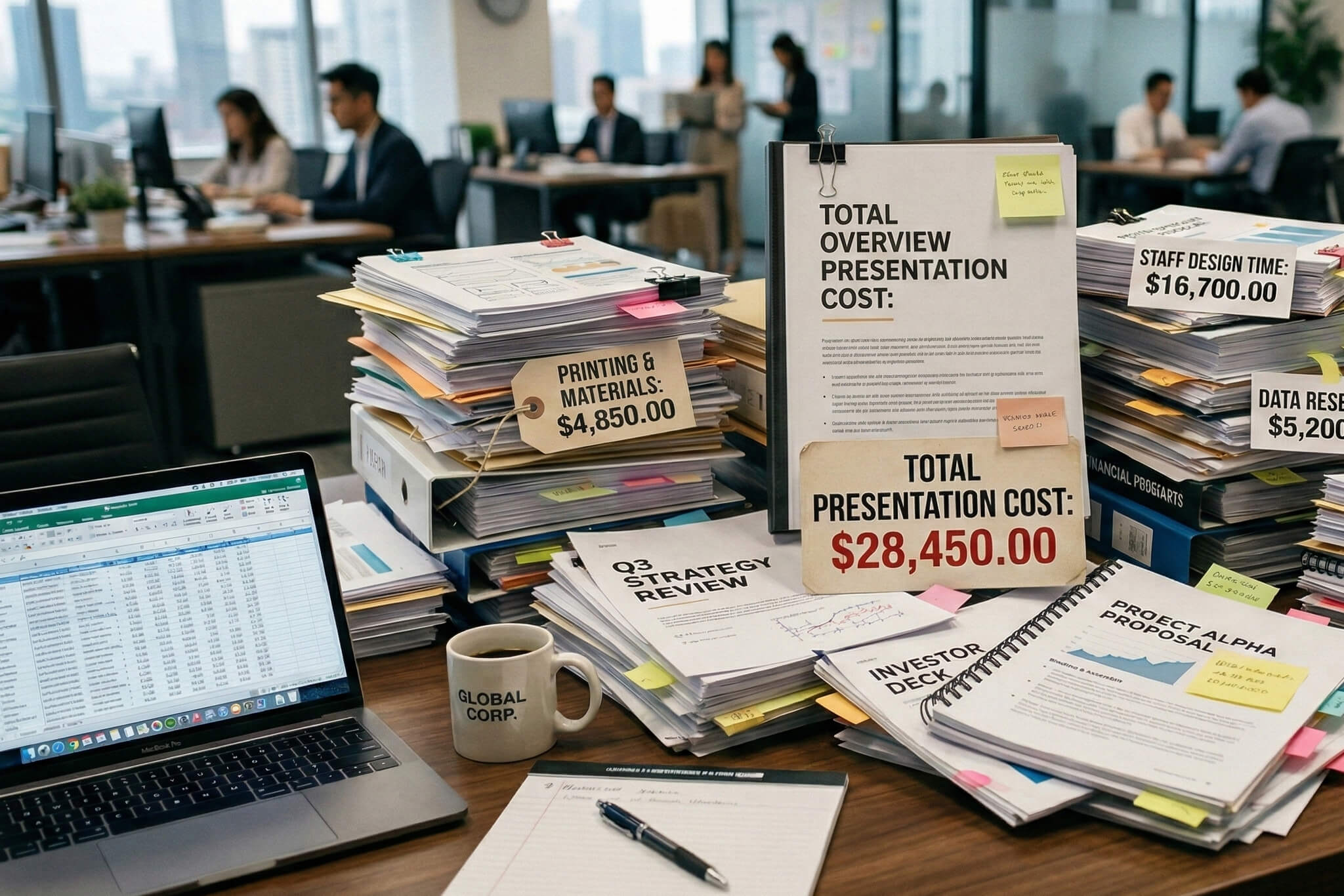
The real problem is that the pitch deck quote a founder budgets for is typically 40-60% short of what the deck actually costs by the time it is in front of investors. Revisions, multiple deck versions, model integration, founder hours - these rarely show up on the invoice. We see it on roughly half of incoming projects.
This article gives realistic 2026 pricing for the actual work, the costs most quotes leave out, and a way to size your pitch deck design cost against the round you are raising. The same approach helped one of our clients close the Legion raise of $2.5M in seed funding. Three drivers shape every pitch deck quote: scope, context, and provider type.
Scope - how much of the work is yours vs the designer's: polish only, or narrative rebuild.
Context - round stage, timeline, industry complexity. The same scope costs more under pressure.
Provider type - DIY tool, freelancer, or agency. Each is a different cost structure, with different price points attached.
Scope sets the floor and the ceiling. A polish-only project lands up to $3,500. Foundational work - restructuring the narrative, building from scratch - takes the budget into higher tiers, with institutional-grade decks reaching $20,000+. Scope is the lever the founder controls most directly, and the lever that swings the price the most.
Context layers on top of scope. The same scope costs more under timeline pressure, more in regulated industries, more at Series A than at pre-seed. Across our projects, context premiums typically run 20-50% on top of base scope. Urgency alone can take a $6,000 deck to $9,000 without changing a single deliverable. Founders consistently underweight context, because it does not surface until the project is already in motion.
Provider type is a structural choice. DIY tools and AI subscriptions run $50-200. Freelance designers typically charge $300-$3,500. Pitch deck design agencies charge $3,000-$20,000+ and bundle narrative strategy, market positioning, and revisions into the engagement. The same scope can come from any of the three; what changes is who carries the strategic load.
Of the three, scope sets the floor and ceiling - $0 on one end, $20,000+ on the other. The next section breaks down what each end of that range actually buys.
The three tiers map to the three scopes founders typically choose between. The choice is best made before requesting a single quote - it is what keeps the quote conversation calibrated.
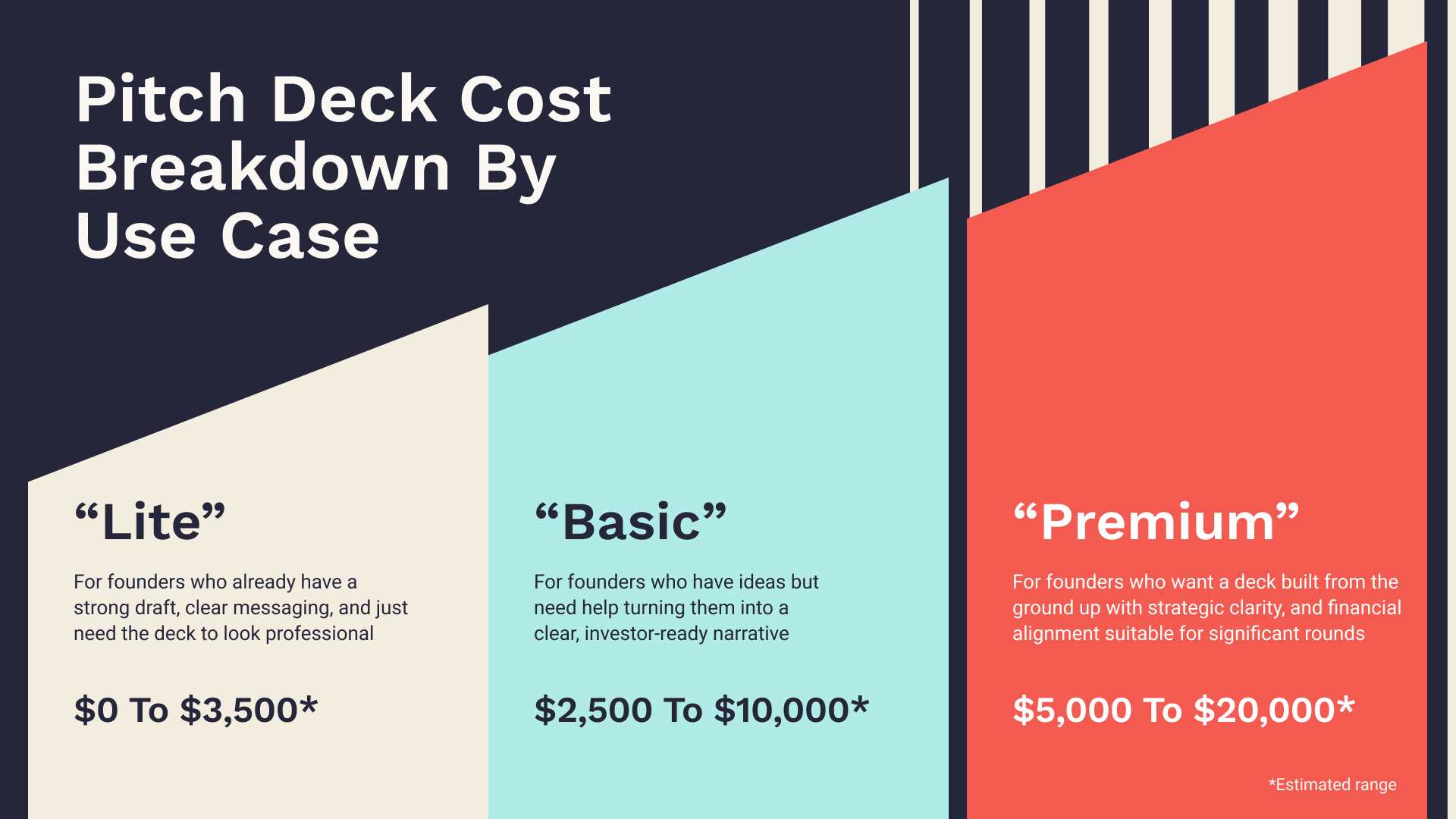
For founders who already have a strong draft and just need the deck to look professional.
Lite is the starting point. The story is locked; design is what is missing. For visual-design projects at this tier, expect $0 to $3,500. The scope typically includes:
Lite is the right scope when the content is locked. It is the wrong scope when the narrative still needs work, because visual polish on a weak narrative produces a weak deck that looks polished. We see this mismatch about once a month: a founder briefs us for design, and the conversation surfaces a positioning problem the design cannot fix.
For founders who have the ideas but need them turned into a clear, investor-ready narrative.
At Basic, the founder is paying for someone to take a set of ideas and build them into a deck that flows. Per Deloitte's venture-capital tracking, investors in 2026 are looking for narrative discipline rather than scale-at-any-cost - a deck that reads as a coherent story now carries more weight than three years ago.
For build-up and restructure projects, expect $2,500 to $10,000. Scope extends beyond Lite:

Basic costs more than Lite because the designer becomes a co-author of the story. The team usually includes a project manager, a researcher, and a senior designer rather than one freelancer.
For founders targeting significant rounds who need full narrative, model integration, and multi-stakeholder support.
Premium engagements are built with the founder, not delivered to the founder. The deck is one output of a longer working relationship - which is why the price is what it is. For full-build projects, expect $5,000 to $20,000+. Premium scope typically includes:

Only a handful of projects land at the $20K+ ceiling - typically Series B+ raises with multiple investor cohorts and full financial-model work.
Looking for a precise pitch design deck cost estimate? Get a quote
💡 Tip. Ask each provider what is not included at the quoted price. Custom illustrations, financial-model integration, additional deck versions, and revision overflow are the four things most often excluded - and most often discovered after the contract is signed.
Across the three tiers, what the budget buys changes more than the price itself. Lite buys polish; Basic buys narrative; Premium buys the full investor package. What none of the three tiers price cleanly is what happens once the work is underway.
Within any tier, five variables push the final number up or down. Two of them are the ones founders consistently miscalculate.
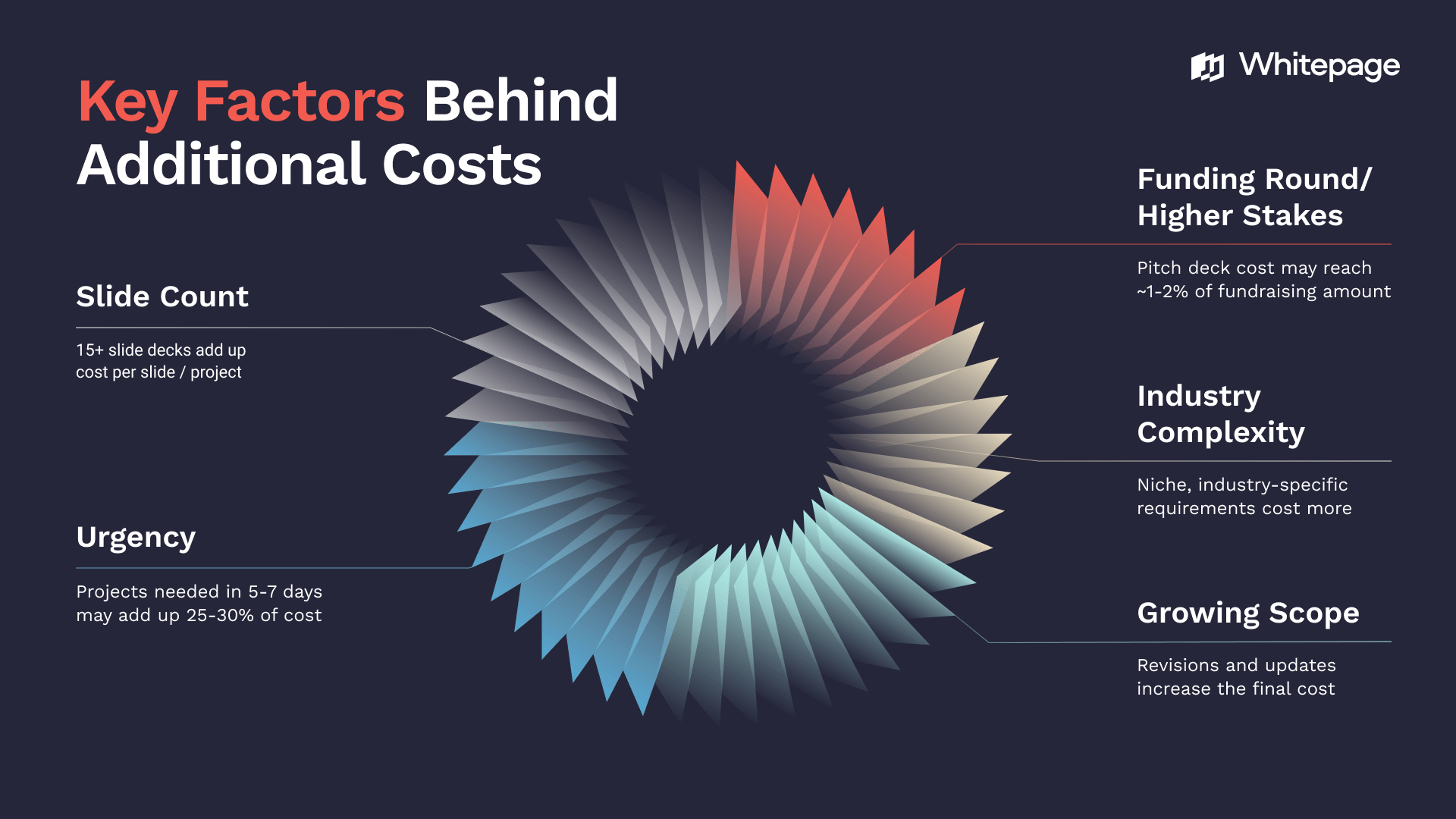
A 10-slide deck typically costs less than a 20-slide one, though the relationship is not linear. A 10-slide investor deck demands tight storytelling and strategic editing - every slide has to work harder, which carries its own design cost. A 20-slide deck offers more breathing room but requires more design work and structural planning to keep the story coherent.
Tight deadlines move the price more than founders expect. A standard pitch deck project runs 2-3 weeks. Anything inside 5-7 days requires reallocating resources and compressing feedback cycles - work providers price at a 25-50% premium above standard. The math: a 50% rush premium on a $6,000 Basic-tier deck is $3,000 the budget did not see coming. Founders who flag urgency early usually pay less than founders who flag it three days before the partner meeting.
💡 Tip. Ask the standard timeline first, then ask the rush rate for half that timeline. Most providers quote 25-50% on top - worth knowing the number before the partner meeting moves.
The 1-2% rule. At pre-seed and seed, the deck budget typically lands at 1-2% of the target round. A $250K-$2M raise translates to a $2,500-$20,000 deck. At Series A and B, the percentage falls below 1% but the absolute floor rises - rarely below $20,000-$50,000 - because the institutional bar is higher.
Treat the 1-2% rule as a sanity check, not a budget formula. A founder spending $15,000 on a deck for a $250K pre-seed raise is over-investing. A founder spending $3,000 on a deck for a $10M Series A is under-investing. The next section breaks the round-sizing logic out in full.
Complex business models cost more to explain clearly. Investors need a straightforward narrative - how money flows, who pays whom, why the model is defensible. As Business Insider reported in December 2025, Menlo Ventures partner Venky Ganesan is calling 2026 the "show me the money" year for AI - investors want real ROI, not roadmap optimism. The Chambers and Partners Venture Capital 2026 guide notes that biotech, healthcare, and fintech deals carry longer regulatory review and expanded diligence on compliance and data-privacy claims - days founders rarely budget, separate from the design invoice.
Scope that expands mid-project is the single most common reason a quote and a final invoice diverge. A deck that starts as "polish the existing draft" becomes "rebuild the problem slide" becomes "and the team slide" becomes "and a teaser version." Each addition is reasonable in isolation. Together, they reset the project from Lite to Basic, or Basic to Premium, without anyone explicitly renegotiating. Write scope changes down as they happen.
Of the five factors above, urgency and growing scope are the ones founders realise too late. Which raises the bigger question this article is really about: what else does the headline pitch deck quote leave out?
The headline deck quote typically covers 40-60% of what the deck actually costs by the time it is in front of investors. The other 40-60% is five line items most quotes do not itemize.
Revision overflow. Most quotes include 2-3 revision rounds. An active raise routinely needs 5-8. Investor feedback shifts the narrative, a new data point lands, a partner suggests reordering the problem and solution slides. Revision overflow typically lands at 25-40% of base cost when the raise runs hot.
Multiple deck versions. A real fundraise needs three decks, not one. The teaser (3-5 slides) for cold outreach. The meeting deck (10-15 slides) for partner conversations. The diligence deck (20-30 slides) for partners who lean in. Most quotes silently price one of the three - a gap founders discover when the first partner asks for "the longer version."
Financial-model integration. The deck cites the model; the model is built separately - in Excel, by a fractional CFO or the founder. Translating model outputs into the data slides (sensitivity charts, cohort projections, unit economics) is real design and data-viz work, and the line is almost always priced apart from deck design.
Custom illustrations and diagrams. A serious deck typically carries 2-4 custom visuals: a market map, a GTM funnel, a product architecture diagram, a team org chart. Stock illustration is rarely investor-ready. Two or three custom diagrams add $800-$2,400 to a base quote.
Founder time. Founders invest 30-60 hours of their own time across the 3-5 week project window - working sessions, content drafts, narrative reviews, internal stakeholder feedback. Once opportunity cost is factored, founder time is usually the largest line item in the engagement. It is also the one founders almost never price in. (what investors look for in a pitch deck sets the bar these hours have to clear.)
Add the five hidden line items together and the realistic total runs roughly 1.4 to 1.6 times the headline quote. A $6,000 Basic-tier quote typically lands at $8,400-$9,600 by the time the deck is investor-ready. The figures above are typical ranges drawn from project experience, not fixed laws - which is why the more useful question is the one the next section is built around.
The right question is not "how much does a pitch deck cost." The right question is "how much should this deck cost relative to the round it has to support."
The absolute number on the quote matters less than its ratio to the raise. A pre-seed deck and a Series B deck do different jobs, support different conversations, and clear different bars - so they cost different amounts, in different ratios to the round.
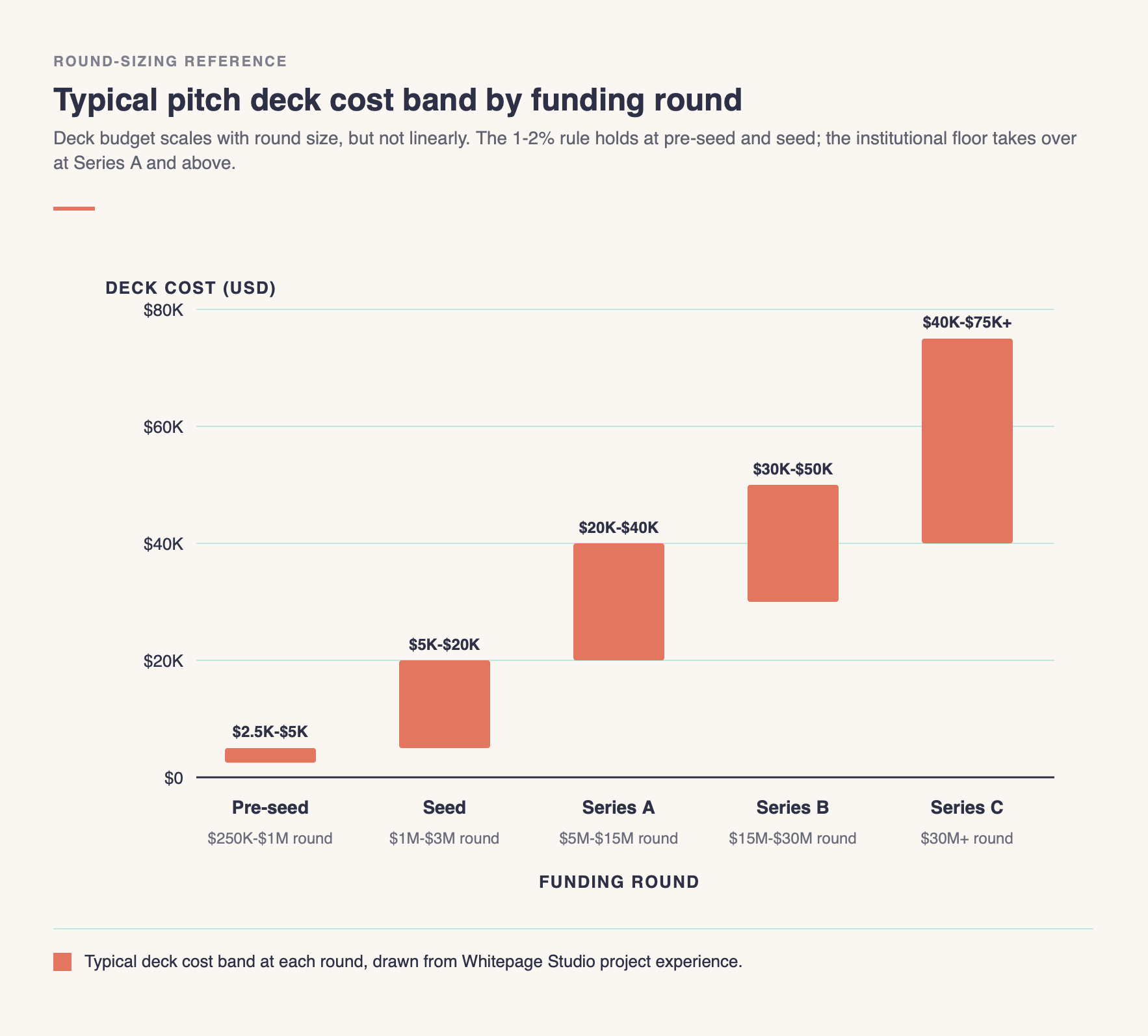
Two practitioner rules size the deck budget against the round.
The two-sided example makes the principle concrete. A founder spending $15,000 on a deck for a $250K raise is over-investing. A founder spending $3,000 on a deck for a $10M raise is under-investing. In client scoping, the round size is the first question we ask - because the answer shapes every other variable in the brief.
Ready to size your own deck against the round?Book a complimentary consultation - we'll scope your deck against the round you're raising.
There is no direct mapping between price tier and vendor type. Lite-scope work can come from an agency. Premium-scope work occasionally comes from a senior freelancer with a fundraising track record. The vendor question is about who is doing the work, with the price following from the structure.
Price range: free-$200. Best for: early drafts, internal alignment, idea exploration. Where to find: Gamma, Tome, Canva, Notion, Pitch, ChatGPT.
DIY is a reasonable place to start. Free templates on Google Slides, Canva, or Figma give a workable skeleton. AI tools - Gamma, Tome, Pitch - help move past blank-page syndrome and generate a rough structure in seconds. For an AI startup pitch deck at the idea stage, AI-tool drafts are often where the work starts.
The catch is recognisable output. Investors who review decks weekly recognise an AI-generated draft on sight. Papermark's 2024-2025 analysis of 2,239 pitch decks found founders have roughly five minutes to land their key messages on first read. A deck that reads as AI-generated reads as a deck the founder did not invest in. Use AI tools for first drafts and internal alignment, not for the version that goes to investors.
Price range: $300-$3,500. Best for: visual design polish on an existing draft. Where to find: Upwork, Fiverr, Behance, Dribbble.
When a founder hires a freelance presentation designer, the founder is paying for visual execution. A skilled freelancer can take a draft and turn it into a sleek, brand-aligned document. The catch we name in scoping calls every week: most freelance pitch deck designers are aesthetic experts, not fundraising experts. They make a slide look beautiful or build interactive elements - but they do not flag a missing market-sizing slide or a positioning problem with the moat. Freelancers are the right call when the founder is confident in the content and the deck needs to pass the eye test for a seed round.
Price range: $3,000-$20,000+. Best for: serious fundraising ($500K-$10M+), competitive rounds, institutional decks. Where to find: dedicated pitch-deck consultancies, design-led fundraising agencies.
Agencies earn their fee when the deck has to do real work in a competitive round. The work bundles narrative strategy, market positioning, visual storytelling, and structured revisions into one engagement, with a team behind the deliverable. A typical agency team carries a creative director for visuals, a copywriter for the narrative hook, and a strategist to keep the deck's investor logic coherent under diligence. Agencies vary in specialty - some narrative-led, some design-led, some research-led. The shortlist question is whether the agency's strength sits against the founder's gap.
The vendor comparison below is a quick reference, not a decision tree - most founders run through it once before requesting quotes.
Whichever vendor type fits the scope, the pricing structure inside the engagement matters as much as the headline number.
Inside any engagement, the pricing model determines how much control the founder has over the creative process and how much protection there is against unexpected costs. Four frameworks cover most engagements.
Hourly pricing (best for audits). Many freelance designers and a handful of agencies use hourly rates for small tweaks or sanity checks. Transparent on the line item; expensive once content is still being shaped, because feedback cycles drag and hours compound.
Per-slide pricing (best for redesigns). The most predictable model for pure design work. A 12-slide deck at $150/slide locks the budget at $1,800. Per-slide fits when the deck structure is set and the work is slide-for-slide redesign.
Project-based pricing (best for end-to-end engagements). The default model for pitch deck design agencies. Project-based covers discovery through final delivery, with the price set against the deliverable rather than the hours. The model aligns the agency to the outcome, not the clock.
Package deals (best for derivative assets). Many specialists bundle the main deck with a teaser, a follow-up template, or a social-share version. Packages are the right call when the deck needs to come with derivatives, not stand alone.
Which model fits which scope is straightforward in most cases. Project-based is the default when scope is clear and the deliverable is end-to-end. Per-slide fits slide-for-slide redesigns.
Hourly suits audits but compounds quickly if content is still being shaped. Package deals are the right call when the deck comes with 2-3 derivative assets.
💡 Tip. Match the pricing model to project complexity before signing, not after. Project-based versus per-slide is a different conversation once scope has expanded - and the version of the conversation that happens mid-project always favours the provider.
The final cost of a pitch deck depends on the scope, the round, and what the deck has to do once it ships. Three steps size the budget realistically before any quote lands.
Define the scope. Lite is visual polish on a strong draft. Basic is narrative work plus design. Premium is a full strategic build. The scope choice is the biggest single driver of cost.
Audit the options. Run the vendor question against the scope.
Communicate the context. Urgency, round stage, and industry shape the final number. A healthcare pitch deck requires different expertise than a consumer-app deck - the provider needs to speak the industry's language, not learn it on the founder's invoice.
At Whitepage Studio, we work with founders through fundraising rounds across industries. If a deck is sitting between a founder and a partner meeting, we are happy to scope it.
One thing to take away. Before requesting a single quote, write down the round being raised and multiply the scope estimate by 1.4-1.6 to get the realistic total. If that total runs above 2% of the round at pre-seed or seed, the scope is too big for the stage.
Tanya Slyvkin is the founder and CEO of Whitepage Studio, a boutique pitch deck design agency. Over 12+ years, the studio has supported founders through $1.5B+ in capital raised across 1000+ projects, with clients including DoorDash, Airbnb, Udemy, Stellaromics, and SHINE Technologies.


It depends on what the deck has to do. For an internal alignment deck or a pre-seed teaser, $0-$500 of founder time on a template is usually enough. A seed-stage investor deck - one that goes into partner meetings - typically lands at $2,500-$10,000 with a freelancer or agency. For Series A and beyond, $10,000-$20,000+ buys the narrative, the data viz, and the multiple deck versions institutional rounds require. The three drivers behind any quote sit in Three drivers behind every pitch deck price above.
Across the projects we have seen, freelance presentation designers charge $300-$3,500 for a deck, depending on experience, scope, and turnaround. Agencies charge $3,000-$20,000+ because the engagement typically includes narrative strategy, market positioning, and multiple revision rounds, beyond visual design alone. Hourly designers run $50-$200 per hour - useful for audits, expensive once feedback cycles drag. The vendor breakdown above covers when each option fits.
Yes, technically. Gamma, Tome, Pitch, and ChatGPT, Claude Design, or Gemini will generate a structured deck from a prompt in minutes. They are useful for moving past blank-page syndrome and for early internal drafts. They are less useful for anything external-facing - investors review hundreds of decks, and an AI-templated draft tends to read as one. In our experience, AI-generated decks land best as a starting point for the narrative work, not as the final artefact. The AI-tools subsection above carries the full thinking.
Guy Kawasaki's 10/20/30 rule is no more than 10 slides, no more than 20 minutes of presentation time, and no font smaller than 30 points. It was written for live PowerPoint pitches and still holds up as a discipline check for any investor deck. If a meeting deck runs over 15 slides or body text drops below 18pt, the deck is working against the format. Use the rule as a constraint, not a prescription.
Most quotes include 2-3 rounds of revisions in the base price. An active raise routinely needs 5-8, because investor feedback shifts the narrative mid-process and partners push for reordering. In the projects we run, revision overflow typically adds 25-40% on top of base cost during a live fundraise. Budget for the overflow upfront rather than negotiating mid-conversation. The full hidden-cost stack sits in The costs founders forget above.


867 BOYLSTON ST
BOSTON, MA 02116


