





























.avif)
.avif)
.avif)

























Get a guide to creating pitch decks presentation



.png)

TL;DR
The AI fundraising landscape in 2026 is historically large ($189B in February alone) but brutally concentrated: the top ten gen-AI startups capture 93% of all funding. The best AI pitch decks cut through this noise by leading with the business problem and earning the right to go deep on technology. Investors spend under two and a half minutes on the average deck, and many now use AI screening tools before a human partner ever sees your file.
February 2026 set an all-time record: $189 billion in global startup funding in a single month, up roughly 780% year-over-year. Here's where the urgency gets personal. AI Series A rounds now average $50-52 million — roughly 30% higher than non-AI startups. That sounds promising, but it also means the bar for what a "fundable" AI company looks like has risen proportionally. Especially when VCs are using AI itself to screen pitch decks: they deploy AI-powered tools to triage pitch decks, benchmark metrics, and run quantitative checks before a human partner ever opens your file. The startups that surface have structured, real-time metrics. The ones that don't surface have a beautiful deck and no numbers.
What this means for your deck: You're not just competing against other AI startups. You're competing against a screening layer that decides in seconds whether your deck deserves human attention. Your first three slides need to pass a machine before they persuade a person. Your traction slide needs data like a public company filing, even at seed. And your defensibility slide needs to answer, in one clear visual, why you won't be the next wrapper that dies when GPT-5 ships.
In this post, we will walk you through best practice of pitch decks – those that stand in the era of disruptive AI, both in front of investors and AI itself.
Over twelve years and more than a thousand projects at Whitepage, we've watched both versions of this problem accelerate. Deep tech founders bury investors in architecture. Vertical AI founders drown in generic positioning. Both miss the same thing: investors in 2026 aren't asking "how does your model work?" They're asking "how deeply embedded are you in the daily workflow?" and "what happens to your margins at scale?"
We get it. But here's the shift most AI founders haven't internalized yet: saying "AI-powered" is no longer a differentiator. Every pitch deck in every VC inbox says that now. The challenge isn't proving you built AI: it's demonstrating what makes yours uniquely defensible. One AI founder told us his slides were "too wordy
These aren't inexperienced people. They're founders who can explain reinforcement learning from human feedback to a PhD panel but freeze when the audience shifts to a partner at Sequoia. The wall isn't knowledge. It's communication. And in a market where 41% of Y Combinator's AI startups shut down within 18-24 months, the ability to translate is no longer a nice-to-have; it's a survival skill.

This is the most common pattern we see in AI startup pitch decks, and the research confirms it. According to Apparate's 2025 analysis, simplifying pitch deck content led to a 60% increase in investor engagement. The instinct to lead with technical depth, to prove you're real, not a wrapper, actually works against you.
Here's why that matters: Investors aren't evaluating your architecture on a first read. They're pattern-matching. They're asking three questions in the first sixty seconds: Is the problem real? Is the market large enough? Does this team have an edge? If your deck answers those questions on slides one through three, you've earned the right to go deep on slides eight through twelve.
If you're building your first deck and want a broader foundation before diving into AI-specific advice, our guide on how to write a pitch deck covers the fundamentals that apply to every startup.
We often tell founders their deck needs to work in two time zones: the two-minute skim and the twenty-minute deep dive. The first is a screening pass. The second only happens if the first one lands.
Funding Blueprint's 2024 data puts the median deck viewing time at two minutes and twenty-four seconds. That number has been shrinking: Zyner reports a 24% drop in investor attention since 2021. And it gets worse for AI companies specifically, because the volume of AI pitches flooding VC inboxes has created a kind of screening fatigue.
What do investors spend that limited time on? SketchBubble found that VCs spent 48% more time on business model slides in 2023 compared to the previous year. Competitive positioning got 110% more attention. Traction sections saw a 25% bump.
What this means for your deck: The slides you think matter most, the ones explaining your proprietary model, probably get skimmed. The slides showing how you make money, who you're beating, and what you've already proven get read carefully. Build accordingly.
Funding Blueprint's research found that the first three slides determine roughly 70% of funding decisions. For an AI startup pitch deck, this means your opening sequence needs to accomplish something specific: it needs to establish that you understand a real problem before you reveal that you've built AI to solve it.
In practice, this looks like a three-slide opening.
Notice what's missing from those three slides: architecture diagrams, model benchmarks, and training pipeline details. Those matter. But they belong later, after the investor already cares.
This sequencing challenge is especially acute in deep tech and AI-heavy companies, where the technology is the founder's identity. Setting it aside, even temporarily, can feel like hiding the best part. It's not. It's earning the right to present it to someone who's paying attention.
Once you've earned attention with the business case, an ai startup pitch deck needs three technical slides that standard decks don't. These are the slides where you prove your edge isn't just a ChatGPT wrapper with a logo on top.
This is the single most important technical slide for AI companies in 2026. It shows investors that your product 1) improves with usage, 2) every customer interaction generates data that 3) trains better models, which 4) attracts more users, which 5) generates more data. A loop, not a line.

The visual should be a clear cycle: User Interaction → Proprietary Data → Model Improvement → Better Product → More Users. UiPath built one of the strongest versions of this: millions of automation tasks feeding back into model training, creating a moat that deepened with every customer.
If you can't draw this loop for your product, investors will notice. MktClarity's 2025 data found that 90-92% of AI wrapper companies, those without a genuine data advantage fail within their first year.
This slide answers one question: what's yours versus what's an API call? After reviewing over a thousand projects, we've found the strongest version of this slide draws a clear line between proprietary technology and third-party infrastructure. No blurring, no vagueness.
Show your stack. Label what you built. Label what you licensed. If you fine-tuned an open-source model, say that. If your proprietary layer is an orchestration system, a domain-specific dataset, or a novel inference pipeline: that's your moat. Name it.
Investors now spend more than double the time on competitive positioning compared to two years ago, according to SketchBubble's data. For AI startups, this slide needs to address what we call "the GPT-5 question": what happens to your company when the foundation model you depend on gets significantly better, or adds your feature natively?
The best decks we've seen answer this proactively with specifics: three patents granted, exclusive data partnerships, regulatory compliance barriers, or deep vertical integrations that create genuine switching costs.
Looking at ai startup pitch deck examples that actually raised funding reveals a consistent pattern: business clarity first, technical depth second.
Perplexity AI raised $25M in their Series A with a demo-driven approach. The deck was long, 47 slides, but it flowed logically from problem to solution to team to traction. The team slide was credible (founders from OpenAI, Google Brain, DeepMind). The product was shown working, not described in bullet points. The key lesson: a live demo beats an architecture diagram.
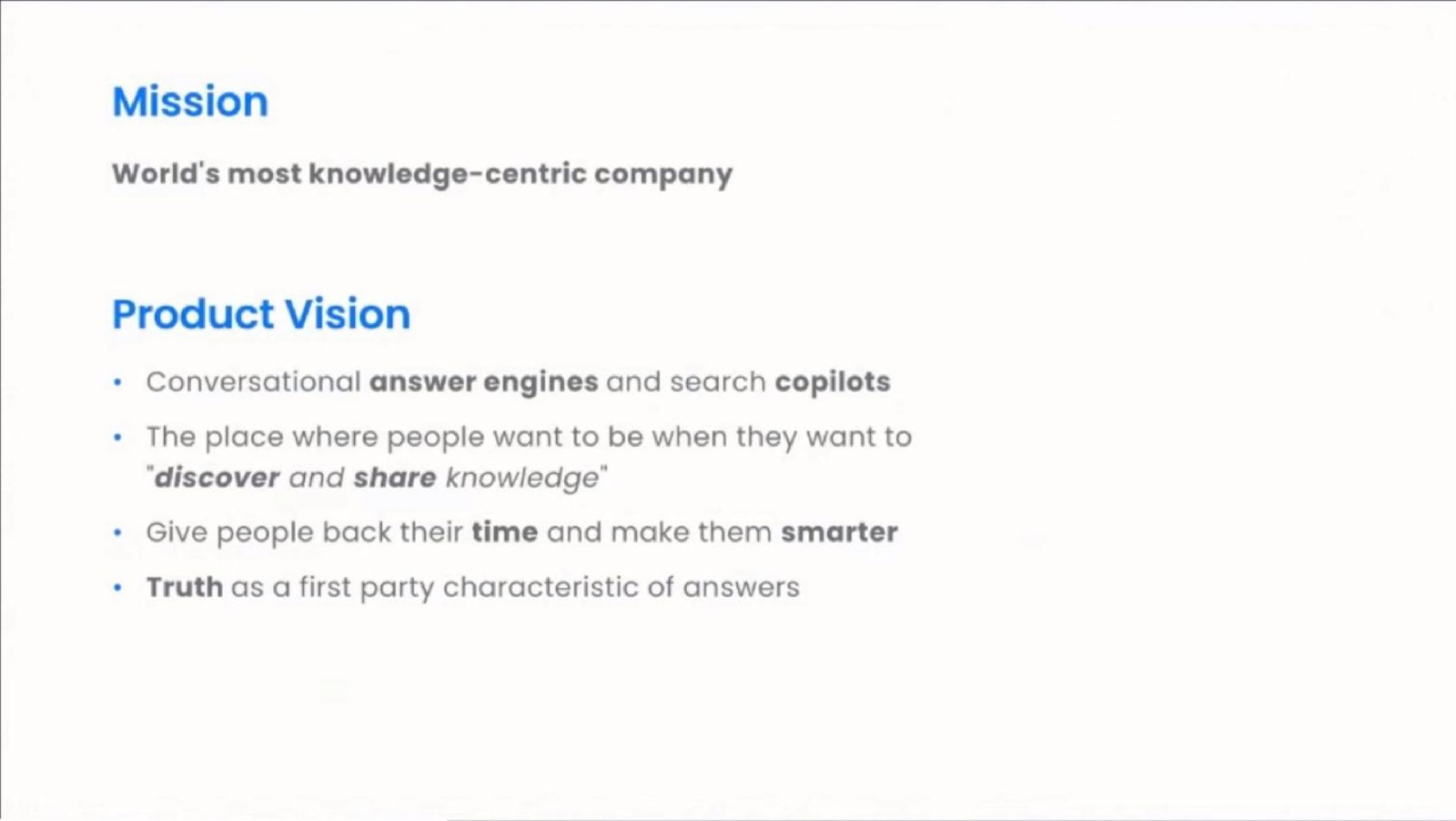
Pruna AI raised $6.5 million with a 12-slide seed deck that did something most AI infrastructure startups get wrong: it led with the cost problem, not the technology. Pruna compresses AI models to make them smaller, cheaper, and faster on any hardware — "similar to a zip that compresses files," as the founders put it. Their deck named Meta, NVIDIA, and Hugging Face as customers before ever showing the technical architecture. The compression engine itself was saved for later slides, after the business case was already clear. EQT Ventures led the round. The lesson: even deeply technical infrastructure plays can open with a business pain.
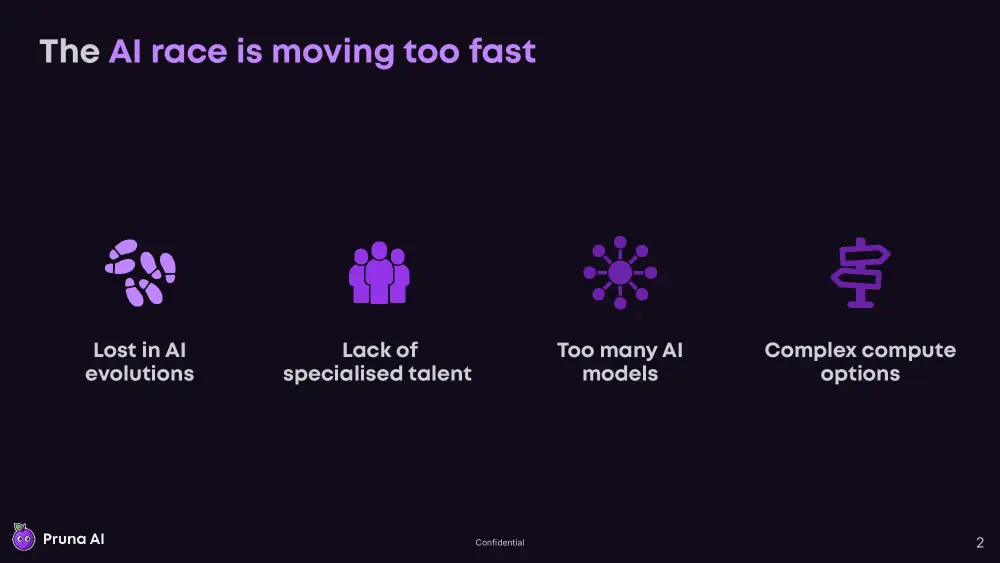
Thoughtful AI took a different path, and it illustrates how vertical focus can sharpen every slide in a deck. The company builds AI agents for healthcare revenue cycle automation, specifically dental care and behavioral health billing. Their 9-slide deck led with a key metric right on the title slide, signaling traction before the investor even clicked forward. After raising over $40 million across multiple rounds from Drive Capital and others, Thoughtful AI's approach shows that the narrower and more specific your vertical, the easier it is to balance technical depth with clarity, because the problem itself does half the explaining.
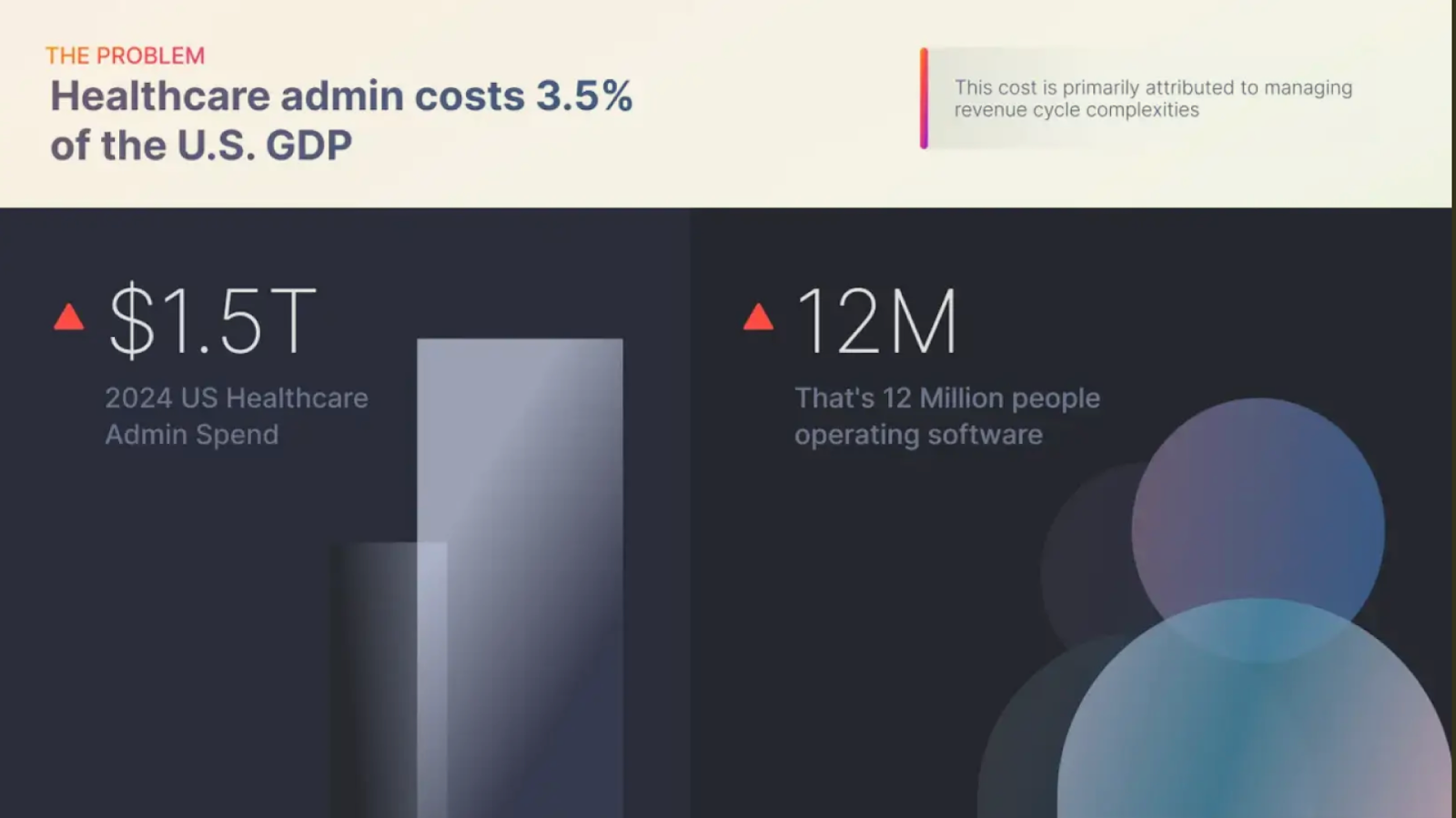
The pattern across all of them: the problem is stated in plain language. Traction is quantified, not projected. The team slide connects specific backgrounds to specific risks. And technical depth is earned, not assumed.
For founders at the earliest stages who want to see how successful decks handle structure, our pre-seed pitch deck examples break down real frameworks that work.
A "wrapper" is an AI product built primarily on top of a third-party foundation model (OpenAI, Anthropic, Google) with a user interface and some prompting logic on top, but no proprietary data, no unique model training, and no deep workflow integration. The product works until the underlying model provider adds the same feature natively or raises API prices. In investor language, a wrapper has no moat: it's a UI layer on rented intelligence.
Here's the uncomfortable reality for AI founders raising in 2026: $202.3 billion went into AI in 2025, according to Crunchbase. That's half of all global venture capital. But most of that money is concentrated at the top. Defensible AI startups command seed rounds averaging $8.9 million, roughly double traditional tech companies, per Vestbee's 2025 data. Companies perceived as wrappers struggle to raise at all.
This is the single biggest strategic question your deck must answer. Not in an appendix. Not in passing. Clearly, on a dedicated slide.
The key takeaway is: if a VC has to ask "what happens when OpenAI adds this feature?" — you've already lost the point. Your deck should preempt the question with a specific, honest answer: your data moat, your vertical integration, your regulatory barrier, your process advantage.
The vertical AI opportunity is real: MktClarity projects that market will grow from $5.1 billion to $47 billion by 2030. But only founders who can articulate their specific defensibility, in plain language, on one clear slide, will access that capital.
If your market size slide tells a compelling TAM-SAM-SOM story but your defensibility slide is vague, the market size actually works against you; it signals opportunity that others can capture more easily.
After twelve years and over a thousand pitch deck projects, including dozens of AI companies across biotech, fintech, enterprise SaaS, and deep tech, here are the ai startup pitch deck best practices we come back to on every project:
This is the kind of challenge our pitch deck consulting process is built for, translating complex AI technology into investor-ready narrative without losing what makes your company defensible.
The founder from that first call, the one with forty-seven slides and the architecture diagram on slide three, eventually shipped a twelve-slide main deck with a ten-slide technical appendix. He raised his seed round in six weeks. The technology didn't change. The story did.
If this is where you are right now: sitting between the technology you've built and the story you need to tell – we're happy to talk it through.


Most successful AI startup decks run 12-15 main slides with a technical appendix of 5-10 additional slides. The main deck covers the business narrative: problem, market, solution, traction, team, and ask. The appendix holds architecture diagrams, benchmark data, and detailed technical explanations for investors who want to go deeper. This structure respects the two-minute screening pass while giving technical VCs the depth they need in a follow-up review.
AI decks need three slides most startups don't: a data flywheel showing how usage improves the product, a technical architecture slide that honestly separates proprietary technology from third-party APIs, and a defensibility slide that addresses the "wrapper risk." These slides prove your company has compounding advantages, not just a clever interface on someone else's model.
Start with the business outcome your technology enables, not the technology itself. Translate your model's capability into a specific, measurable result for a specific customer. Then use the main deck to tell that business story and reserve your technical appendix for the engineering details. We've seen this approach work across deep tech companies from biotech to enterprise AI — the principle is consistent: earn attention with the problem, then go deep on the solution.
Yes, a demo or at least demo frames are among the strongest elements in an AI deck. Perplexity AI's Series A success was largely demo-driven: showing the product working, not describing it in bullet points. If a live demo isn't feasible in a static deck, include annotated screenshots or a short screen recording that investors can click through. Showing beats telling, especially when your product's value is experiential.
Investors look for specifics, not claims. A strong moat slide quantifies your advantage: number of proprietary data points, patents granted or pending, exclusive partnerships, regulatory certifications, or vertical integrations that create switching costs. The slide should also address what happens as foundation models improve — does your advantage grow or erode? Companies preparing for a product launch presentation alongside their investor deck should ensure this defensibility narrative is consistent across both materials.


867 BOYLSTON ST
BOSTON, MA 02116


