





























.avif)

.avif)
.avif)



























Get a guide to creating pitch decks presentation



.png)
TL;DR
The why now slide exists to answer one investor question that never gets asked out loud: if this is such a good idea, why hasn't someone already won this market?
That's the real pressure behind the slide. Not "tell me why the market is growing." Not "convince me this problem is real." Investors will have followed you that far in the deck already. What stops them is the timing question. The why now slide is where you address it directly.
Sequoia's pitch framework, which has shaped how a generation of investors and founders think about deck structure, lists "Why now?" as a required answer and notes that the best companies almost always have a clear answer here. That's not a suggestion. It's a signal that when a great investor looks at your deck, they're actively looking for your timing thesis. If it isn't there, they'll notice.
The distinction that matters most: the why now slide is not a market size slide in disguise. It's not about how large the opportunity is. It's about why the window to capture it is open now in a way that it wasn't before, and why it may not stay open indefinitely. If you're working on how to write a pitch deck from scratch, this is the slide that ties your problem and solution to a specific moment in time.
A founder I worked with recently, building a hardware compliance automation platform, described her why now thesis perfectly in our first call. She talked about how several things had converged in the last two years that made her product newly viable: compliance frameworks becoming machine-readable, AI reaching a capability threshold that actually worked in production, and a regulatory environment that was tightening rather than loosening. "Two years ago," she said, "you couldn't have built this company."
That's a real timing argument. Sharp, specific, causal.
When I looked at her deck, the why now slide said: "AI is transforming the hardware industry. The market is growing exponentially."
It's the most common gap I see, and it shows up across four failure modes worth checking your own deck against:
There's a contrarian view worth engaging with here. Some experienced founders argue you shouldn't isolate the why now argument on its own slide at all, arguing that timing is better woven through the problem, market, and traction sections. That's not wrong, exactly. But it misses the real issue. The problem isn't the slide format. It's that most timing arguments aren't sharp enough to survive on their own, so founders either hide them in other slides or dilute them across five bullets. The fix isn't to scatter the argument — it's to strengthen it until it can stand up.
Here's something worth separating: the why now argument and the why now slide are not the same thing, and confusing them leads to bad decisions in both directions.
Airbnb's famous 2008 deck didn't have a standalone why now slide. The timing case (that the 2008 financial crisis was pushing people to rent out spare rooms for income, and that trust in peer-to-peer transactions was growing) was threaded through the problem and solution sections. It worked because the timing thesis was woven into every claim, not because it had its own real estate.
Seek, the AI code generation company, led with a single steep performance chart. Generative AI code generation accuracy went from 0% to 72.3% between May 2020 and August 2021. That's a threshold crossing — a moment where the technology went from not viable to clearly viable. That argument deserved its own slide because it was the entire case. You couldn't have embedded it anywhere else without losing its impact.
The question to ask yourself: is my timing argument strong enough to carry a slide on its own? If you have a specific, dated, causal case for why this window exists now, give it the real estate. If your argument is still fuzzy, distributing it across the deck won't fix the fuzziness. Strengthen the argument first.
This is also worth considering if you're building an AI startup pitch deck specifically, where the timing argument has to do more work than ever. OpenVC puts it bluntly: "You should have a why now slide. Always." But they immediately add the caveat: timing won't rescue a deck where the product story is still muddy. And First Round's research found that AI startups in particular no longer have the luxury of long stealth periods. Launch decisions are increasingly swayed by the answer to "why now." When every founder can say "AI is transforming our industry," the investors evaluating your deck are running sharper filters, not looser ones. According to OECD data, AI firms captured 61% of all global VC investment in 2025 ($258.7 billion out of $427.1 billion total). That kind of concentration doesn't make timing arguments easier. It makes weak timing arguments more visible.
We ask every client three questions before we touch the slide. Answer these in writing (full sentences, not bullet points) and the slide structure will follow naturally.
Question 1: What couldn't exist 24 months ago?
This is the technology or infrastructure question. Something has to have changed externally that makes your model newly viable. It might be a cost curve crossing a threshold (model inference costs dropping 10x), a platform reaching critical mass (enterprise adoption of AI copilots), or infrastructure becoming available (a regulatory framework that didn't exist). If your honest answer is "nothing has changed technically," your timing argument lives somewhere else: in behavior, regulation, or competitive structure. That's fine. But you have to find it.
Question 2: What behavior has demonstrably shifted in the last 18 months?
Consumer habits, enterprise buying patterns, workforce norms, regulatory posture: something measurable that you can tie to a date or a named event. "Remote work changed how teams collaborate" is too vague. "Enterprise software buyers now approve AI tools through IT in under 30 days, versus 6+ months in 2022" is a timing argument. The difference is specificity and recency.
Question 3: Why does waiting cost your investors money?
This is the window question, and most founders skip it entirely. What happens in the next 12–18 months if a well-funded competitor moves, an incumbent wakes up, or the regulatory window closes? A timing argument isn't complete until it explains not just why now is good, but why later is worse. This is what makes investors feel the cost of not acting — which is the emotional outcome the slide is built to create.
Once you've answered these three questions clearly, you'll know whether you have a standalone slide or a thread to weave. You'll also know what visual format serves the argument: a curve that crossed a threshold, a convergence of parallel forces, a checklist of barriers removed.
If you're not sure which format to use, look at what your argument is actually claiming. We cover the problem-solution framing in detail elsewhere; the why now slide is upstream of that. Get the timing case right and the rest of the narrative becomes easier to build.
The most useful thing we can do here isn't give you another framework. It's show you how five real companies made five structurally different timing arguments, and why each one chose the approach they did.
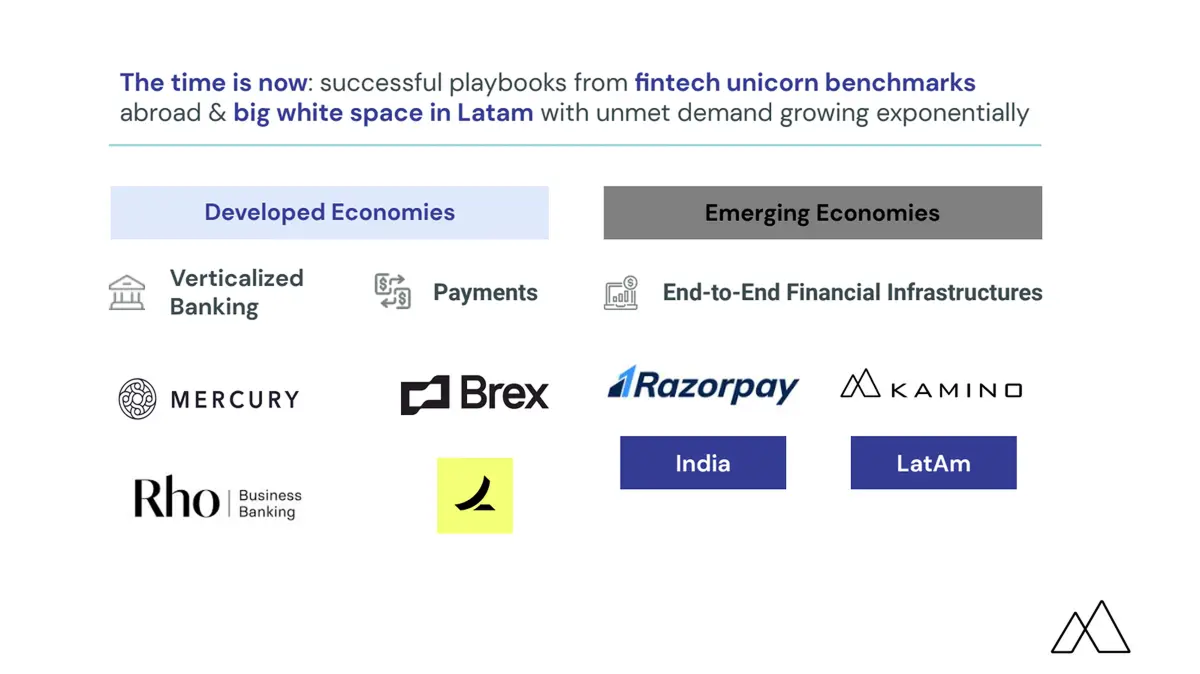
Kamino's slide split the screen between developed economies (Mercury, Brex, Rho) and emerging economies (Razorpay, Kamino). The argument wasn't about a new technology or a regulatory shift. It was about geographic arbitrage. The model has been proven at scale in the US and India. LatAm is the equivalent white space. This works because investors don't have to believe in an abstract thesis. They have to believe that a copy-and-adapt play in an underserved market will work when the analog has already produced unicorns elsewhere.
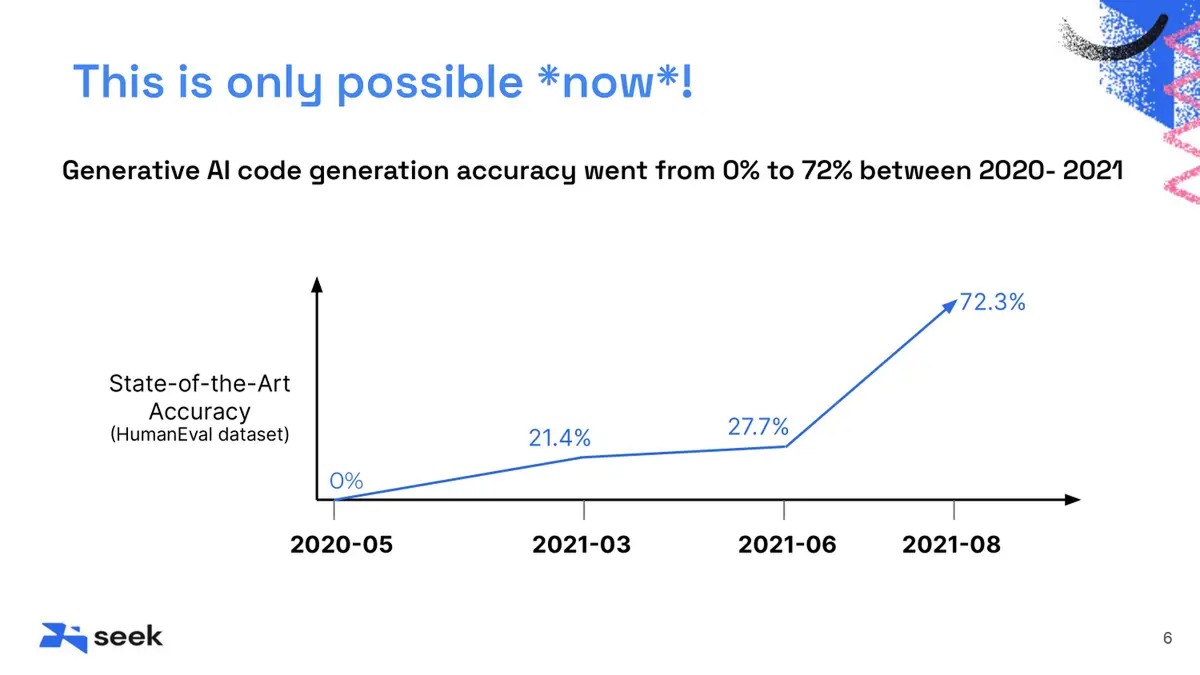
Seek led with a single steep line chart: generative AI code generation accuracy went from 0% to 72.3% in roughly 15 months. No market size, no trend language. Just a performance curve that crossed the viability line. This is the right approach when your product depends on a specific technical capability that recently became production-ready. The argument is irrefutable because it's measurable. Before that threshold, the product category didn't exist. After it, it did.

No charts. No data. Just three lines on a full-bleed red background: Tech works ✓. Safe & scalable ✓. Carbon markets unlock global scale. Vaulted was operating in a space with a long history of failed climate tech promises, and they knew it. So instead of making a growth argument, they made a barrier-removal argument. Each line is a resolved investor objection. The timing wasn't defined by what was coming. It was defined by what was no longer in the way.
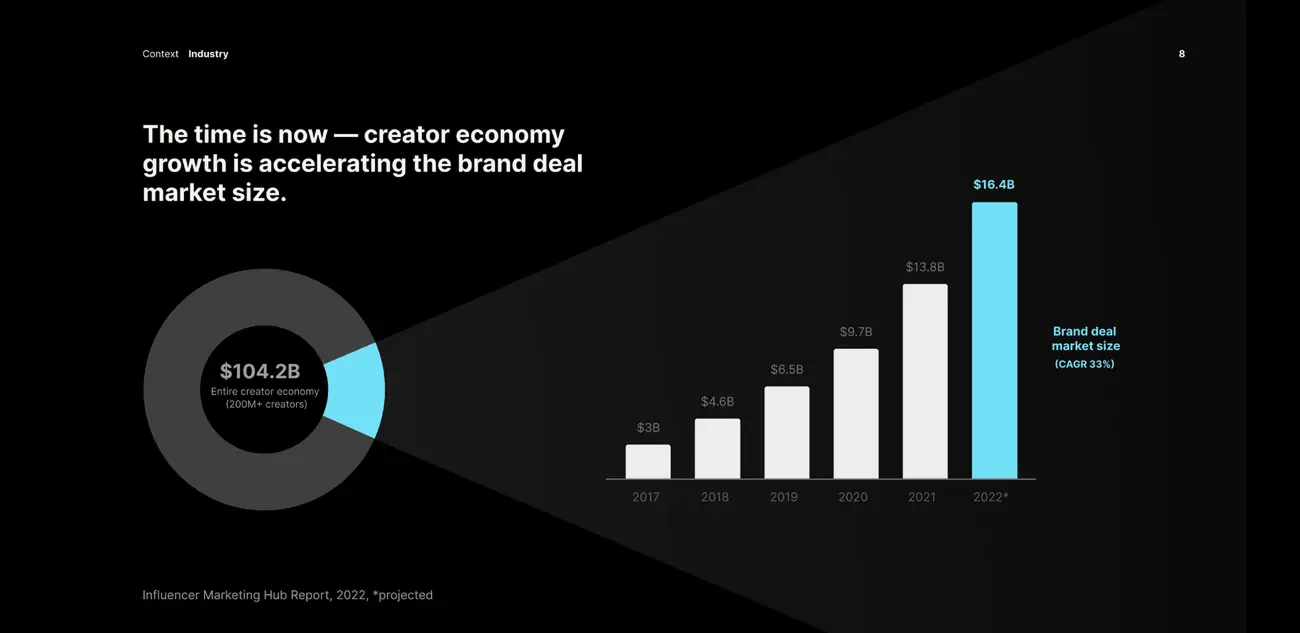
July's slide showed a donut chart ($104.2B creator economy) with a bar chart climbing from $3B in 2017 to a projected $16.4B in 2022, a 33% CAGR in the brand deal sub-segment specifically, per the Influencer Marketing Hub Report 2022. The key move here: they didn't cite the broad market. They isolated the segment most relevant to their model and showed it was in its acceleration phase, not its maturation phase. This avoids the trend report failure mode because the data is specific to the exact wedge they're entering.
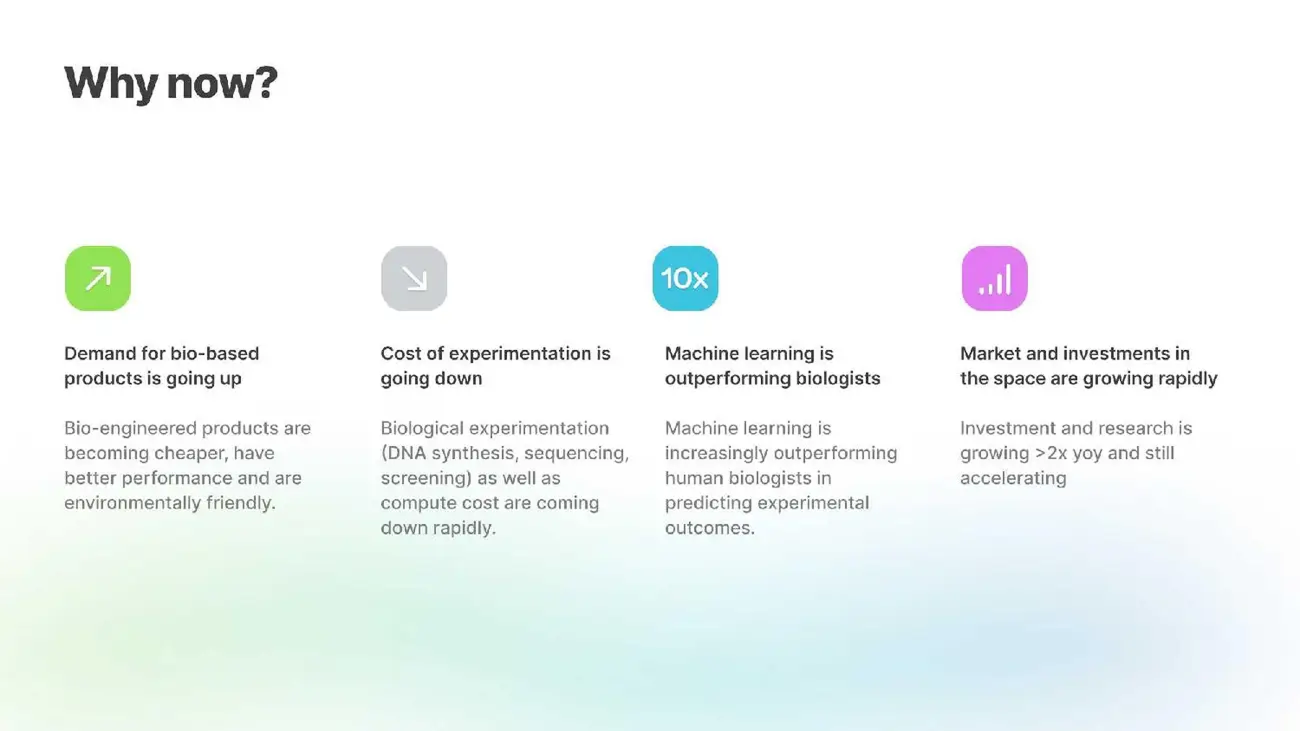
Cradle used four equal-weight columns: demand for bio-based products going up, cost of experimentation going down, machine learning outperforming biologists, and investment in the space accelerating. Each force reinforces the others. No single shift is the argument — the convergence is. This is the strongest structure when your company sits at the intersection of multiple external tailwinds and you can show that each one would be insufficient alone, but together they create a specific and durable window.
Read your headline out loud. Then ask: would this sentence have been equally true in 2022?
If the answer is yes, rewrite it.
"AI is transforming our industry" — true in 2022. "The regulatory framework that blocked our model was updated in Q3 2024, opening the first legal pathway for this approach in the US market." That sentence wasn't true in 2022. One of those is a timing argument. The other is wallpaper.
This test matters more than it used to. According to Qubit Capital's analysis, AI startups attracted $131.5 billion in VC funding in 2024, up 52% year over year, and seed-stage AI startups are receiving a 42% valuation premium over non-AI peers. That concentration of capital doesn't lower the bar for timing arguments. It raises it, because every deck in an investor's inbox this quarter is making some version of the "AI timing" claim. The ones that stand out are the ones that can say specifically what changed, when it changed, and why that particular change makes their model newly viable.
Once your timing argument is solid, the rest of your financial narrative follows logically. There's a direct line from a credible why now case to credible financial projections, because if the window is real, the growth curve has a structural basis, not just an optimistic one. And a strong timing thesis makes your use of funds slide far easier to justify: investors who believe the window is real will want to know exactly how you're deploying capital to capture it.
If you know your timing is right but every version of the slide comes out flat, that's usually a sign the argument needs sharpening before the design does. We've spent 12+ years helping founders compress complex timing theses into one clear slide, across 1,000+ decks and $1.5B+ raised by our clients.
If you're ready to work on yours, you can see how we approach pitch deck design or get in touch directly to talk through where you are in the process.


A why now slide is a dedicated slide that explains why the current moment is the right time to build and fund this specific company. It answers the investor question: why would this succeed today that wouldn't have worked two or three years ago? A strong why now slide identifies specific external shifts in technology, regulation, behavior, or competitive structure. These shifts have recently made the company's model newly viable and time-sensitive.
Most effectively, immediately after the problem slide and before or alongside the solution. Placing it early frames the rest of the deck as a response to a specific, time-sensitive opportunity rather than an abstract product pitch. Some founders place it after the market slide to connect market context with timing. Both placements work as long as the narrative logic holds.
The market slide answers "how large is the opportunity?" The why now slide answers "why is this the right time to capture it?" Market size is structural: it describes the landscape. Timing is situational: it describes a window. A why now slide built around growth curves or TAM numbers is actually a market slide in disguise, and it misses the point. The timing argument should be about recent, specific external changes, not about how big the pie is.
Not necessarily. The why now argument is always essential; investors are always asking the timing question, whether or not you address it explicitly. The why now slide earns its place when your timing argument is specific and strong enough to carry its own real estate. If it isn't, weaving timing through your problem, market, and traction sections is a better approach than isolating a weak argument on its own slide. Strengthen the argument first, then decide on the format.
Data that is recent (2023–2026 where possible), sourced (named report or institution), and specific (a percentage, a cost figure, a performance metric, a named regulatory event). Strong data types include: a cost curve that has declined sharply, a technology benchmark that crossed a viability threshold, a regulatory change that opened a previously closed market, or a behavioral shift with measurable adoption numbers. Avoid undated or unsourced claims, as they signal that the timing thesis hasn't been stress-tested.


867 BOYLSTON ST
BOSTON, MA 02116


