





























.avif)
.avif)
.avif)


























Get a guide to creating pitch decks presentation



.png)

We know how this goes. An investor intro lands in your inbox. The conference is in two weeks. The CEO wants to see something by the end of January. Suddenly a pitch deck that's been sitting at "almost ready" for three months needs to be done by Friday.
Deadlines create decks — that's just how it works. After 12+ years and 4,000+ pitch deck projects helping clients raise $1.7B+, we've seen almost every version of this scenario. And we've learned exactly what separates the founders who ship something great under pressure from those who send out a deck they're quietly embarrassed by.
This guide is our honest breakdown of that. What to move fast on, what to protect no matter the timeline, and how to sequence the work so you're not redoing everything the night before.
The first thing to get clear on is what the timeline actually allows.
A pitch deck built in 48 hours is not the same as one built in two weeks. Both are possible. Neither is automatic. And the difference isn't how hard you work — it's knowing in advance which parts of the process are compressible and which aren't.
Here's how we think about the four phases, and where time can actually be saved:
This is deciding what your deck is about. What's the one thing each slide needs to establish? What order does the narrative run? Where does the investor's skepticism live, and when do you address it? This work takes as long as it takes. Cutting it produces decks that look complete but read as confused.
Writing slide copy is faster than most founders expect once the structure is locked. With a clear wireframe, a focused founder can draft all 12–15 slides in a day. The trap is writing before the structure is set — which produces content that has to be rewritten anyway.
Custom design takes time. But "custom" doesn't always mean "elaborate." Clean typography, a consistent color system, and one strong visual per slide will outperform a complicated deck built under pressure. What cannot be compressed: brand alignment, readability, and slide-by-slide visual logic.
The fastest decks we've delivered at Whitepage — some in under two weeks, start to finish — all had one thing in common: the founder reviewed the wireframe seriously before we moved to design. One round of real feedback early saves three rounds of revision at the end.
Understanding which phase you're in at any given moment is the first practical skill in building a deck under pressure.
Investors spend an average of 2 minutes 24 seconds on a pitch deck — down 24% since 2021. You are not building a document. You are building something that has to earn attention in under three minutes from someone who has seen 1,500 decks this year and will remember fewer than five of them. That context should shape every decision about where your time goes.
The founders who ship good decks fast are not working harder than everyone else. They're clearer about what the deadline actually requires, and ruthless about everything it doesn't.
Compress aggressively on slide count. Funded early-stage decks average 19–20 slides. The best-performing seed decks use 10–14. Every slide past 15 risks never being seen — completion rates drop sharply beyond that threshold. Under a deadline, a deck that forces you to prioritize is a feature, not a constraint. Anything that doesn't directly advance the investment decision belongs in the appendix, not the main deck.
Compress on design complexity. Custom illustration, animated transitions, elaborate data visualizations — these take time and add marginal value compared to clean, consistent slides with clear visual hierarchy. Investors are not evaluating your Figma skills. They are trying to understand your business in the time it takes to skim a page. A simple, consistent visual system applied quickly will outperform an elaborate design built under pressure every time.
Compress on redundant proof points. Under a deadline, founders tend to include every piece of traction in multiple places, just to feel covered. Pick the three strongest metrics and place them where they land hardest. The rest belongs in the data room.
Do not compress the story. This is the part that consistently gets sacrificed under time pressure, and it's the part that determines whether any of the other work matters. Specifically: the problem slide needs to be specific and felt, not a generic gesture at market pain. The narrative logic between slides needs to hold: each slide should earn the next. The ask needs to be clear, tied to milestones, not buried. And every slide needs at least one real reason to believe: a metric, a quote, a named proof point that earns its 21 seconds.
Y Combinator's guidance frames the stakes plainly: you earn each additional minute of investor attention by leading with your most impressive proof first. If you make them wait for the compelling evidence, you may not get to it.
The reason story work gets cut under pressure is that it's the hardest to produce. Problem framing requires genuine clarity about what you're solving and for whom. Narrative logic requires stepping outside your own expertise and asking what a smart stranger needs to understand first. These aren't writing tasks; they're thinking tasks. And under a deadline, thinking is what gets rushed first. That's the trap.
The fastest way to a working deck is a wireframe. Not slides — a document. One line per slide, describing what that slide establishes for the reader.
It looks like this:
Ten slides. Maybe twelve. Each with a single, clear job. If you can write this document in one sitting, you have the spine of a working deck. If you can't, no amount of slide design will fix it.
Understanding how to structure this sequence is the highest-leverage skill in building a deck under time pressure. It's also the step most often skipped in favor of jumping straight to PowerPoint.
The market size and "why now" slides are where founders lose the most time under a deadline. Here are three sources that give you defensible numbers quickly:
Statista: Best for TAM/SAM figures, industry forecasts, and regional breakdowns. Their Market Insights sections give you a "$Xbn today, growing to $Ybn by 20XX" headline with historical data behind it. Investors recognize the source. Use it for your market size slide and cite the base year explicitly.
CB Insights: Best for showing capital momentum in your category. Their State of Venture and sector reports (AI, fintech, health tech) give hard funding numbers that serve as credible proxies for market activity. Use it for your "why now" slide when you want to show that capital is already flowing into the space.
MarketsandMarkets / Fortune Business Insights / IMARC — Best for vertical-specific CAGR numbers when Statista doesn't have your exact niche. Pick one, quote the base year, forecast year, and growth rate, and show the source name on the slide. For higher credibility, cross-reference two providers — if both show mid-teens CAGR, the number is harder to challenge.
The strongest market slide pairs one specialist research report (Statista, MarketsandMarkets, IMARC) with one institutional source (OECD, WIPO) — precise figure plus macro credibility in a single slide.
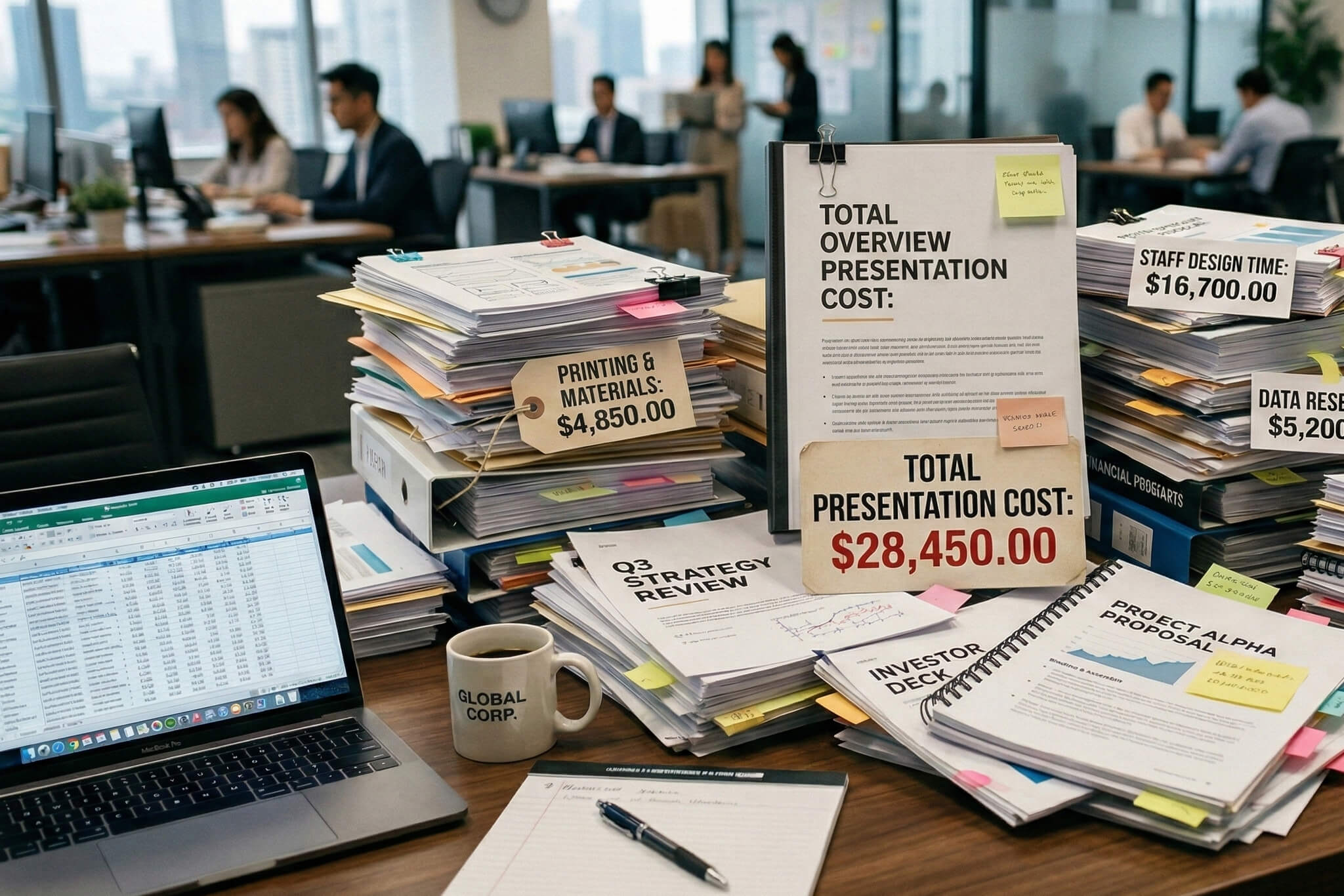
Once the wireframe is locked, you still have to make the deck look like something a serious investor would take seriously. This is where the real tradeoff lives — and where the decision depends on how much time, money, and quality tolerance you actually have. Urgency tends to add on pitch deck design costs.
There is no option that is fast, cheap, and high quality. Pick two.
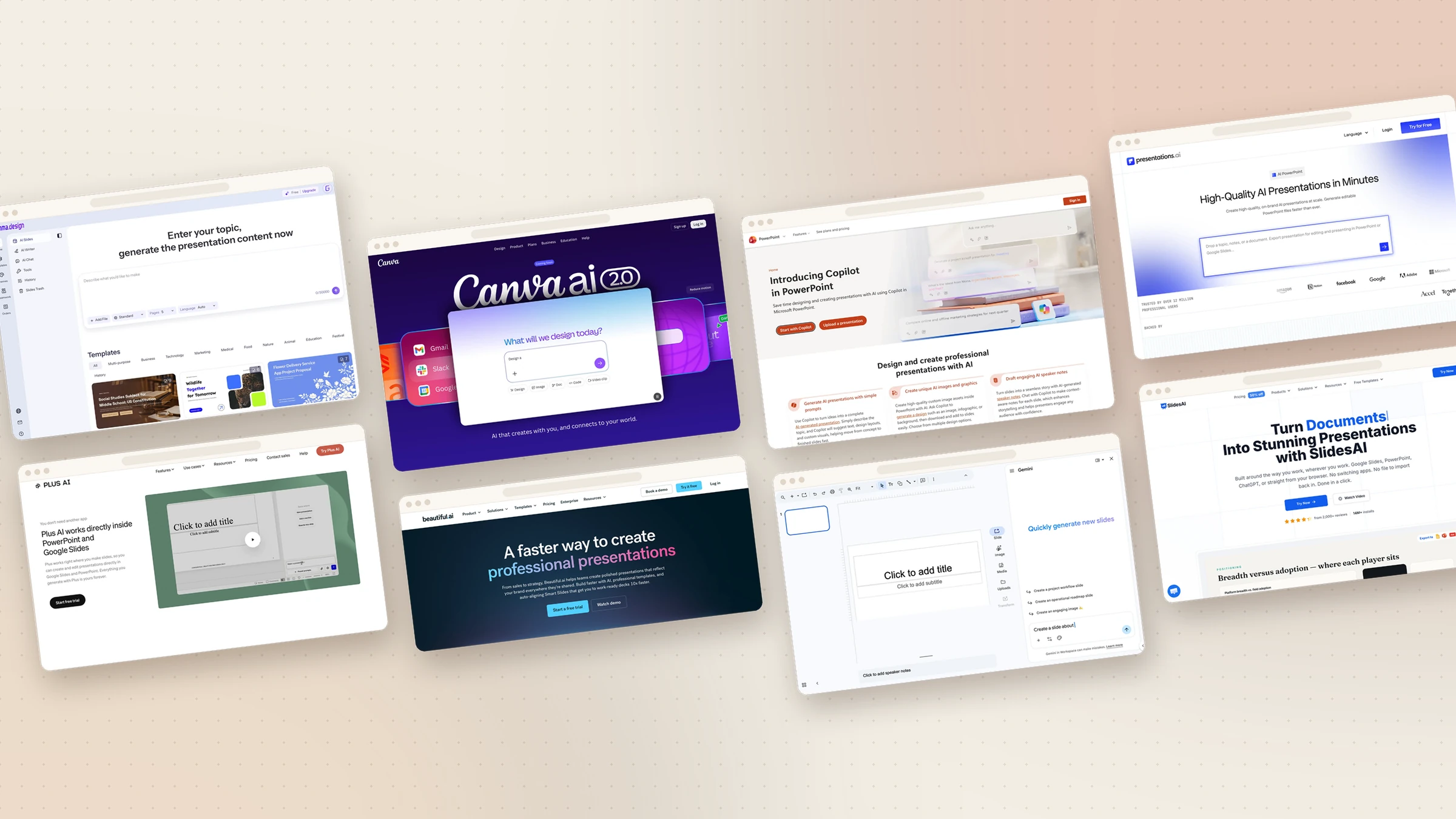
Tools like Canva, Beautiful.ai, and Gamma can generate a presentable deck quickly using templates. If you have a locked wireframe, strong copy, and a good eye for layout, this is a legitimate path. The ceiling is real — template-based decks tend to look like template-based decks, and investors see hundreds of them. But if your deadline is 48 hours and your story is airtight, a clean template beats a rushed custom design every time. The risk isn't the tool — it's using it before the story is ready and letting formatting decisions substitute for narrative ones.
A freelance designer can take your content and produce something visually polished faster than an agency. The gap is the strategic layer — most freelance designers are executing your brief, not reviewing your narrative. If you hand them a wireframe with a clear visual direction, you'll get good output. If you hand them a rough draft and expect them to figure out what matters, you'll spend the time you saved on revision rounds. Freelancers work best when the content is already locked.
A full-service agency handles both content and design, which is why the timeline is longer and the price is higher. The value isn't speed in isolation; it's the absence of rework. When narrative and design are built together by people who understand how investors read, you don't spend a week revising slides because the story changed after the design was done. For high-stakes moments — a first meeting with a tier-one fund, a Capital Markets Day, a board review with a hard date, the cost of a weak deck in that room is usually larger than the cost of getting it right. The full breakdown of what affects pitch deck pricing is worth reading if you're trying to scope the investment.
The honest framework: If your deadline is under a week, the realistic options are DIY or a freelancer, with a fully locked wireframe before either one starts However, that may impact the end result: our best advice is to follow this track if you’re confident in your story, narrative, and metrics. If your deadline is less tight and the stakes are high, a specialized agency is the more efficient path, because you're not paying for design separately from strategy. You're paying to not redo the strategy after you've seen the design. In addition, the agencies are usually open for negotiation when it comes to tight deadlines – even if their website say the opposite.
What doesn't work under any timeline: handing a designer (or an AI tool) an unlocked narrative and hoping the slides clarify the thinking. They won't. The deck will look better and read worse, and you'll have less time to fix it. in addition, high-impact demands like Series A round pitch decks will not stand when made by a freelancer fast. A full-stack pitch deck design agency is where it should land.
The honest answer is: AI is genuinely useful for the first 70% of a pitch deck. It can generate a reasonable structure, draft placeholder copy, and get you to a coherent skeleton faster than starting from a blank slide.
The problem is the remaining 30%, and in a competitive fundraising environment, that's where decks actually win or lose.
AI-generated decks tend to share the same structural failure regardless of the tool used: the logic holds, the format is correct, but the specificity is missing. The TAM slide says $50 billion. The financials show $10 million in year three. Nobody builds the bridge between those numbers. The competitive moat reads like it was pulled from a category overview. The problem statement could describe any of fifteen companies in the same space.
This is the pattern we see in our intake process consistently. Founders arrive with ChatGPT-drafted decks that are 70% there, and genuinely don't know why they aren't landing. The structure looks right. The sections are all present. But the deck doesn't accumulate into a convincing argument because no one made the hard calls about what to emphasize, what to cut, and how to sequence the evidence.
By 2025, 87% of founders were using AI in their pitch process. Inbound decks to investors increased 10–15%, while the term "AI deck spam" started appearing in VC firm communications. More decks, same attention window, lower differentiation. The founders who stood out were not the ones who avoided AI; they were the ones who used it for drafting and still invested in the thinking.
What AI cannot do: decide which proof point is most credible for a specific investor profile, identify where your narrative loses momentum, translate a complex technical advantage into a line that a generalist investor understands at 21 seconds per slide. Those are judgment calls. They require someone who has seen thousands of these decisions made, understands what investors are actually scanning for, and can read when a story is coherent versus when it only looks that way.
Yes, with the right sequencing.
The decks we deliver at Whitepage typically run two to three weeks from kickoff to final file. That's not because the work is slow. It's because the work is sequenced properly: content first, design second, one real feedback round between each phase, no iteration loops caused by designing before the story is locked.
The timeline breaks down when phases overlap. Founders who start designing before the wireframe is approved spend twice as long on revisions. Founders who skip the wireframe entirely and go straight to slides spend three times as long — because every design decision gets relitigated when the content changes.
If you're building independently under a real deadline, here is a realistic fast-track schedule:
Ten days is achievable if you don't restart the wireframe at Day 6.
For the full picture of what a well-built deck looks like at each stage — and where most pre-seed founders stall — the pattern is consistent across hundreds of projects: the bottleneck is almost always narrative, not design.
Not every deck needs an agency. If you have a clear story, real design skills, and a timeline longer than two weeks, building independently is a legitimate choice. The resources exist — how-to guides, structure frameworks, cost breakdowns — and the fundamentals are learnable.
The signal that you need outside help is specific: when you've iterated two or three times and something still isn't landing, but you can't identify what. That stall has a cost. NFX's research on investor behavior puts it plainly: founders who understand how investors think raise more money, faster, at better terms. The inverse is also true. Weeks spent iterating on a deck that isn't working is time the fundraising process isn't moving.
The second signal: when your deadline is genuinely tight and the stakes are genuinely high. A deck you need in ten days for a warm intro to a tier-one fund is not the moment to experiment with self-build. The asymmetry of that outcome, the cost of a weak deck in that meeting versus the cost of getting it right, is usually the calculation that brings founders to us.
Building a pitch deck fast is a skills problem, not a time problem. The founders who move quickly without losing quality are not working harder — they're starting from a clearer brief, staying in sequence, and making the narrative decisions before the design decisions.
The corners you can cut: slide count, design complexity, redundant content, anything that belongs in the appendix rather than the main deck.
The corners you cannot cut: the story logic, the problem framing, the one proof point per slide, and the ask. These are the parts investors actually use to decide whether to take a second meeting. They are also, not coincidentally, the parts that take the most thinking, and therefore the first to disappear under pressure.
If you're building your deck right now, start with the wireframe. Write the ten-line document before you open PowerPoint. Get someone outside your company to read it. If they understand what you do, who it's for, and why it matters after reading ten sentences, you have a deck. Everything after that is execution. Not sure if your story is landing? We review pitch decks before they go to investors.Talk to a pitch deck strategist →


A focused founder with clear content and design skills can build a working early-stage deck in 10–14 days with proper sequencing. Rushing the narrative phase — not the design phase — is what causes most timelines to collapse. At Whitepage, our standard turnaround is two to three weeks, covering both content and design.
AI tools can get you to a solid structural skeleton quickly and are genuinely useful for first drafts. The risk is the 30% they consistently miss: narrative coherence, credible specificity, and the judgment calls about what an investor actually needs to see. Most founders who use AI alone arrive at a deck that looks right but doesn't accumulate into a convincing argument. Use it for drafting; don't use it as a substitute for story decisions.
AI tools can get you to a solid structural skeleton quickly and are genuinely useful for first drafts. The risk is the 30% they consistently miss: narrative coherence, credible specificity, and the judgment calls about what an investor actually needs to see. Most founders who use AI alone arrive at a deck that looks right but doesn't accumulate into a convincing argument. Use it for drafting; don't use it as a substitute for story decisions.


867 BOYLSTON ST
BOSTON, MA 02116


